.svg)

Rappi Case Study | Scaling Paid Media Operations Through Automation and Dynamic Geotargeting

.png)
About The Company
Rappi is a leading Latin American on-demand delivery and super-app ecosystem. Founded in Bogotá, Colombia in 2015. It connects millions of consumers with restaurants, groceries, pharmacies, retailers, and more through a single mobile platform. Today Rappi operates in nine countries across the region, providing fast delivery services, digital commerce experiences, and financial tools via its app. 
Rappi goes beyond food delivery to offer a wide range of services from express retail and grocery delivery to fintech products as well as features for tasks, travel, and e-commerce. Its multi-vertical marketplace leverages a broad network of couriers and partners to meet diverse everyday needs. 
In recent years, Rappi has expanded its ecosystem to include services that deepen engagement and convenience for users and merchants alike, cementing its role as a technology-driven engine of digital commerce across the region.
Executive Summary
Rappi, a leading delivery and quick commerce platform in LATAM, needed to scale paid media execution without increasing manual operations.
Muttdata partnered with Rappi to design and implement Megatron, Rappi’s internal paid media automation platform, now running in production for several months. Megatron increased creative deployment capacity over 500% , while reducing time-to-market over 80%
By automating creative uploads and enabling dynamic geotargeting, the solution reduced manual operational effort by 60–70%, allowing marketing teams to shift focus from execution to reporting, insights, and campaign optimization while unlocking advanced local targeting strategies that were previously impossible to execute with precision.
The solution replaced manual, person-dependent workflows with a scalable operating model, allowing local marketing teams to execute campaigns faster, more consistently, and with a level of geographic precision that had previously been impossible to achieve.
What We Did
The Challenge
Rappi’s paid media operations faced two structural challenges that limited scalability:
Manual creative uploads across multiple platforms
Creative inputs were defined by marketing teams using Google Sheets and stored in Google Drive. From there, operations teams manually uploaded each creative (images or videos) into Meta, TikTok, and Google Ads, following platform-specific and business specific rules for campaigns, ad groups, and ad sets.
This process was:
- Highly manual and repetitive
- Dependent on the individual operators’ knowledge
- Difficult to scale across countries and campaigns
- Prone to inconsistencies due to undocumented business rules
Dynamic Geotargeting Beyond Platform Limitations
Rappi operates across multiple markets and frequently adjusts geographic priorities based on business needs. However, advertising platforms impose structural constraints on how geographic targeting can be configured and updated.
These limitations created friction between business-defined geographic priorities and platform-level targeting capabilities. As a result:
- Many desired geotargeting strategies were operationally complex to maintain
- Some advanced local targeting use cases were difficult to execute with precision
- Updating geographic configurations required significant manual coordination and platform reconfiguration
Megatron addressed this gap by abstracting platform constraints and enabling business-driven geographic updates to be translated automatically into compliant media configurations—without exposing teams to the underlying technical limitations.
The Solution
Muttdata designed and built Megatron, as part of the Rappi Martech initiative: a production-grade paid media automation platform deployed on AWS and fully integrated with Rappi’s existing business workflows.
Automated creative management
- Built all required code resources, database models, and processing services to support massive creative uploads.
- Deployed the full infrastructure on AWS, orchestrating workflows with Airflow and leveraging managed storage and persistence layers.
- Standardized cross-media campaign and ad group taxonomies to ensure deterministic relationships between creatives and targeting resources.
- Enabled automated activation and deactivation of creatives at the campaign and ad group level.
- Implemented execution status reporting and notifications, allowing non-technical users to understand outcomes and resolve issues without engineering support.
Business logic codification
A significant part of the work involved translating Rappi’s implicit operational knowledge into explicit, governed rules. Muttdata worked closely with Rappi’s teams to:
- Unify platform-specific execution logic
- Formalize decision rules that had never been documented
- Encode those rules into a repeatable, auditable system
This reduced dependency on individual operators and created a scalable foundation for future growth.
Dynamic geotargeting through optimization
A central differentiator of Megatron is its ability to operationalize Rappi’s highly dynamic and business-driven geographic definitions, something that traditional ad platform workflows were not designed to support.
Advertising platforms, however, impose strict constraints:
- Geotargeting is typically defined using points and radius-based circles, not polygons.
- There are hard limits on the number of geographic definitions that can be applied per campaign or ad group. These limits are significantly more restrictive when configurations are managed through platform user interfaces than through APIs (for example, dozens of locations via UI versus hundreds via API). In addition, geotargeting models differ across platforms: while Meta and Google Ads rely on point-and-radius logic, TikTok requires targeting based on predefined platform locations. Addressing this required standardizing both automated and manual input sources across all three platforms, ensuring consistent geotargeting behavior despite fundamentally different platform constraints.
- Manual configuration through platform interfaces makes frequent updates impractical and error-prone.
To bridge this gap, Muttdata developed a geotargeting optimization engine within Megatron that translates Rappi’s business-defined geographies into platform-compatible targeting configurations.
Starting from polygon based inputs, the system computes a finite and optimized set of circles that best approximates the intended region while respecting platform constraints such as:
- Minimum and maximum allowed radius
- Maximum number of circles per campaign or ad group
The optimization minimizes a formally defined error function, balancing two competing factors: over-coverage, where ads are shown in areas that should not be included, and under-coverage, where relevant areas are not reached. In addition, the algorithm favors solutions that achieve comparable accuracy using fewer circles when additional complexity does not produce a meaningful reduction in error, ensuring efficient and platform-compliant targeting configurations.
This approach enables precise control over how closely the platform-level targeting matches Rappi’s real operational footprint.
Crucially, these geographic definitions are fully dynamic and managed through business inputs. Marketing teams can activate or deactivate cities, adjust priority regions, or update custom segments without manual reconfiguration in each ad platform. Changes made in a Google Sheet propagate automatically through Megatron to the corresponding campaigns and ad groups.
As a result, Megatron enabled Rappi to execute geotargeting strategies that were previously impossible to deploy with accuracy, while also making frequent updates operationally viable. What was once a rigid, manual process became a flexible, scalable capability aligned with real business needs and local market dynamics.
What makes this capability particularly impactful is that it does not merely optimize an existing workflow, it enables an entirely new class of geotargeting strategies. Before Megatron, some scenarios were operationally infeasible to execute with accuracy. The complexity of these definitions, combined with platform limitations and manual configuration effort, meant they were either approximated or not executed at all. By shifting geotargeting from a manual, interface-driven task to an automated optimization problem, Megatron turned geography into a flexible, business-controlled variable, making frequent updates, high granularity, and cross-city segmentation not only possible but practical at scale.
Outcome
Impact
Key impact areas include:
Scalability and automation
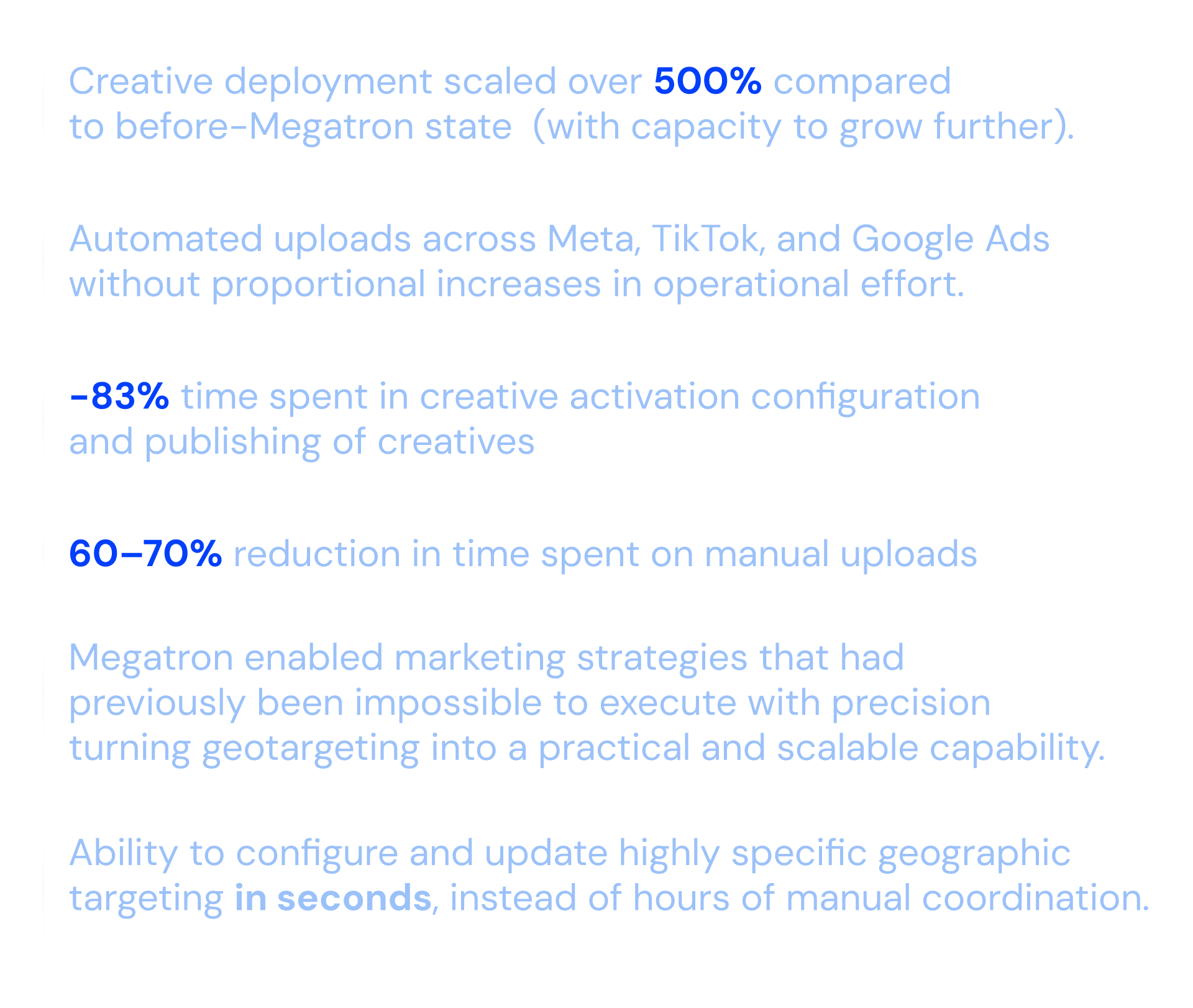
- Creative deployment scaled byover 500% compared to before-Megatron state (with capacity to grow further).
- Automated uploads across Meta, TikTok, and Google Ads without proportional increases in operational effort.
Operational efficiency
- 60–70% reduction in time spent by teams on manual creative uploads.
- Shift from repetitive execution to higher-value activities such as reporting, insights, and optimization.
- Reduced dependency on platform-specific manual configurations and individual operator knowledge.
Speed to market
- Creative activation time reduced drastically, improved times by 83% .
- Near-real-time recalculation and redeployment of creatives and targeting configurations.
Advanced geotargeting enablement
- Ability to configure and update highly specific geographic targeting in seconds, instead of hours of manual coordination.
- Execution of dynamic, hyper-granular geotargeting strategies that were previously impractical or impossible to maintain manually.
Wrap up
Through this engagement, Muttdata helped Rappi transform paid media execution into a scalable, automated operating model designed for growth across LATAM. By codifying complex business rules, automating creative deployment, and enabling dynamic, high-precision geotargeting, Megatron shifted marketing execution from manual operations to controlled, repeatable processes.
Beyond efficiency gains, the solution unlocked new marketing capabilities and provided a future-ready foundation for continued expansion. The partnership reinforces Muttdata’s role as a strategic partner capable of translating complex business needs into robust, production-grade automation platforms that deliver long-term value.
Do you want similar results for your e-commerce platform? Book a call with us!
