.svg)

mrge | A Data Platform Migration to Databricks, Delivered On Time


Executive Summary
mrge, the most trusted performance marketing platform, needed a data platform migration to support massive data volumes, complex pipelines, and growing operational demands — without disrupting a business processing billions of tracked links a year.
As legacy systems struggled with large-scale updates, data consistency, and operational stability, mrge began a Databricks data migration, moving from ClickHouse and BigQuery to a modern lakehouse.
Muttdata partnered with mrge’s Data organization to accelerate this transition, improve data ingestion and transformation processes, and build a scalable lakehouse architecture capable of supporting both analytics and operational use cases.
The result: a more reliable, cost-efficient, and scalable data platform—delivered on time and ready to serve as a foundation for future growth and adoption across the organization.
About the Company
mrge is the most trusted performance marketing platform, operating globally across the affiliate ecosystem.
The company connects more than 5,500 publishers, 80,000 advertisers, and 200 affiliate networks, enabling e-commerce businesses to scale their sales through performance-driven strategies.
Through brands such as MaxBounty, Shopping24, DigiDip, and Yieldkit, mrge has built a complex and distributed ecosystem that generates billions of tracked links per year, translating into more than €2 billion in additional e-commerce revenue for its clients.
At this scale, data is a core business asset. The ability to ingest, process, and activate large volumes of performance marketing data is essential to delivering accurate reporting, optimizing campaigns, and supporting downstream business systems.
The Challenge
mrge operates in a high-volume, multi-source data environment, where data is continuously ingested from databases, APIs, files, and event-based systems.
As the platform scaled, its existing architecture—based on a cloud data warehouse—began to show critical limitations.
Data Update Complexity at Scale
One of the most significant challenges was handling updates on large historical datasets.
Updating transactions associated with older events (e.g., clicks from months ago) required heavy merge and upsert operations, which introduced:
- Unpredictable processing delays
- Pipeline instability and failures
- Frequent need for manual intervention
Additionally, ClickHouse did not guarantee strong consistency, meaning updates were not immediately visible. This directly impacted the reliability of reporting and business metrics.
Costly Workarounds and Operational Burden
To maintain consistency, mrge relied on full dataset refreshes across tables with 100M+ records, resulting in:
- Hours of daily compute time
- Increasing infrastructure costs
- Hidden operational overhead (retries, monitoring, manual fixes)
These inefficiencies made the platform increasingly difficult to scale.
Fragmentation and Growing Complexity
The challenge was further compounded by:
- Multiple data sources (databases, APIs, files, streaming events)
- Integration of multiple acquired companies
- Increasing demand for reliable data across analytics and operational systems
Migration Under Time Pressure
mrge had already begun migrating to Databricks, and by this stage most of the core pipelines, dbt models, and main tables had been moved from the legacy platform. However, the internal data team was balancing migration work with daily operational responsibilities. With a critical final stretch still ahead, internal teams identified a clear risk: they would not meet their migration timeline without external support, particularly to ensure business teams and stakeholders could properly adopt the new platform.
The Solution
Muttdata partnered with mrge as a strategic execution partner, working closely with internal Data Engineering and Infrastructure teams to accelerate the data platform migration while improving the reliability, scalability, and efficiency of the platform.
Muttdata joined the project as a strategic execution partner in the critical final stage. By that point, the bulk of the technical migration was already advanced, and the priority shifted to closing the project on time and ensuring business adoption. Muttdata's role was to add technical capacity alongside the internal team, accelerate the final push, and focus specifically on the reporting layers: validating, correcting, and optimizing the dbt models that powered business reports, revenue metrics, and other critical downstream outputs.
Building a Scalable Lakehouse Architecture
At the heart of the Databricks data migration was a new architecture built on a Lakehouse approach — centralizing storage and processing in Databricks and implementing an ELT workflow with a Medallion Architecture data model.
This enabled mrge to:
- Ingest data from multiple heterogeneous sources
- Process and transform data at scale
- Serve data for both analytics and operational use cases (Reverse ETL)
Data Ingestion Optimization
mrge’s ingestion layer was redesigned to handle different data types efficiently:
- Airbyte for:
- Relational databases (MySQL, PostgreSQL)
- APIs (e.g.,Salesforce)
- Relational databases (MySQL, PostgreSQL)
- Databricks Spark Jobs for:
- Event-based data arriving directly in S3 (JSON Lines format)
- Event-based data arriving directly in S3 (JSON Lines format)
This hybrid approach allowed the team to:
- Optimize ingestion strategies (full refresh vs incremental)
- Reduce unnecessary processing
- Improve scalability and cost efficiency
Orchestration and Data Transformation
The platform uses a modern ELT stack:
- Airflow for orchestration
- dbt for transformations
- Delta Lake as the storage format
Data is processed through a Medallion architecture:
- Landing → raw data
- Staging → cleaned, normalized, deduplicated
- Reporting → business-ready metrics and datasets
This structure ensures:
- Data ownership is central
- Improved data quality
- Scalable transformations
Improving Data Consistency and Update Efficiency
One of the most critical improvements was enabling efficient updates on large datasets.
With Databricks, mrge was able to:
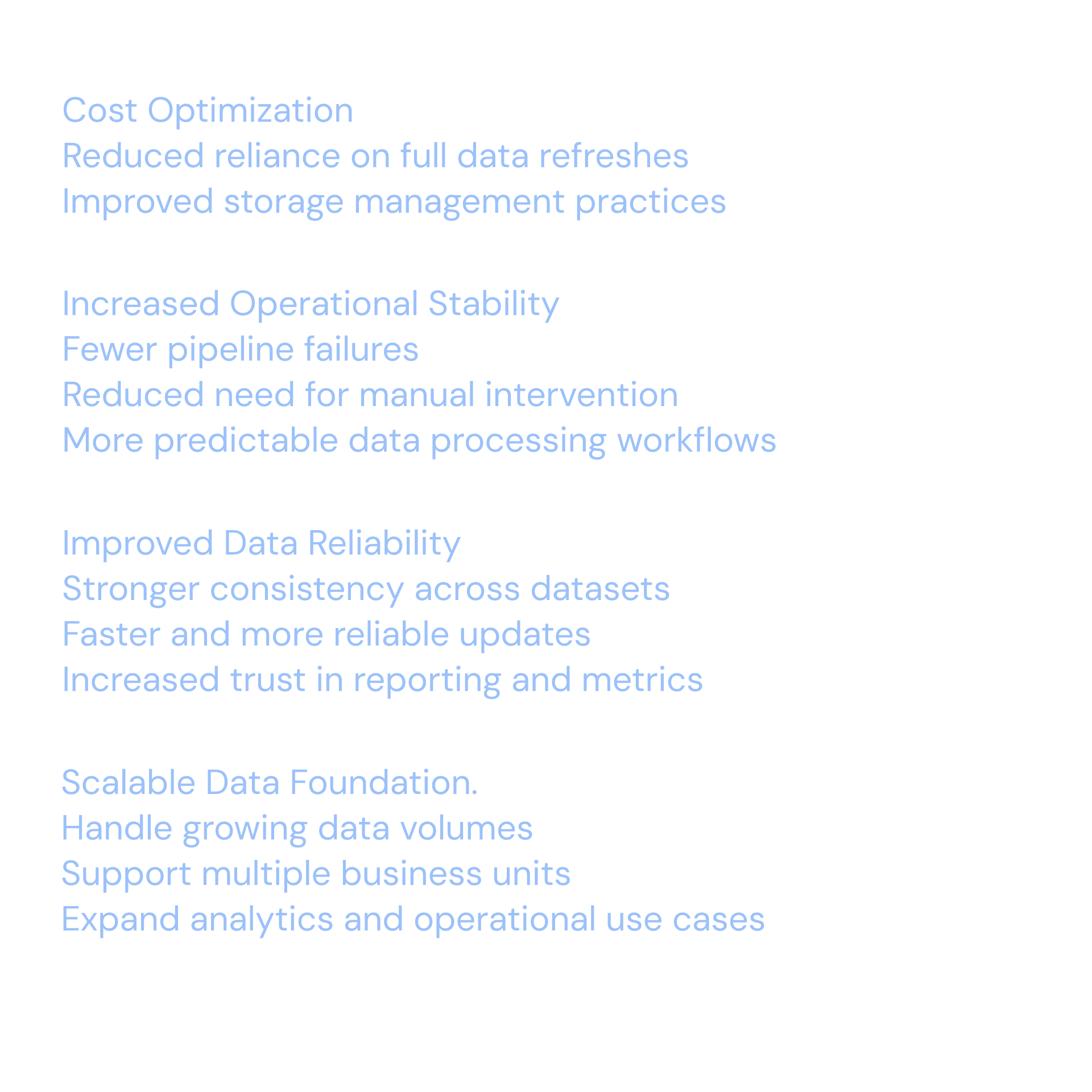
- Avoid heavy full table refreshes
- Execute incremental updates more reliably
This eliminated one of the main operational bottlenecks and significantly reduced pipeline instability.
Enabling Analytics and Operational Use Cases
The platform was designed to support both analytics and operational workflows:
- BI consumption
- Tableau directly connected to Databricks
- Tableau directly connected to Databricks
- Reverse ETL
- Data activation in systems such as Salesforce and DynamoDB
- Data activation in systems such as Salesforce and DynamoDB
This ensured that data could be used for reporting.
Infrastructure and Cost Control
The platform is deployed using Infrastructure as Code:
- Terraform for AWS and Databricks resources
- ArgoCD for service deployment (e.g., Airbyte on EKS)
Additionally, clear operational practices were established:
- Managing external tables in S3
- Cleaning unused data
- Controlling storage costs
Closing the Final Stretch: Reporting Layer Focus
Once the foundational pipelines had been migrated, the final stage focused on the layers closest to the business. Muttdata worked alongside mrge's data team to:
- Validate and reconcile reporting models against the legacy platform
- Correct inconsistencies surfaced during migration
- Optimize dbt models powering revenue and business-critical dashboards
- Ensure smooth adoption by analytics and business stakeholders
This focus on the final mile was decisive in turning a technically advanced migration into one that was production-ready and trusted by the business.
The Impact
The collaboration between mrge and muttdata delivered measurable improvements across performance, cost, and operational efficiency.
On-Time Migration Delivery
mrge completed its migration within the expected timeline. With a small internal team balancing migration work and daily operations, the final stretch was the highest-risk phase of the project. Muttdata's involvement provided the added capacity needed to close the project on time and with business confidence in the new platform.
Wrap-Up
mrge's data platform migration was driven by the need to handle scale, improve reliability, and reduce operational complexity in a high-demand environment.
By partnering with Muttdata, mrge not only completed a critical migration on time, but also solved fundamental challenges in data consistency, pipeline stability, and cost efficiency.
Today, mrge operates on a modern lakehouse architecture that supports both analytics and operational use cases—positioning the company to continue scaling its data capabilities with confidence.
Do you want to scale your data capabilities? Contact us
