.svg)

Social Learning Case Study | AI-Driven CPA Reduction

.png)
Inside the Experiment: How to Validate AI’s Impact on Marketing Efficiency for Social Learning
Performance marketing teams are constantly under pressure to maximize conversions while strictly controlling costs. In a dynamic digital environment, securing leads efficiently requires constant, precise calibration of ad budgets. Can AI help marketing teams gain a competitive edge?
We recently partnered with Social Learning to conduct a rigorous A/B test, comparing traditional campaign management against our AI Paid Media Optimizer.
In this report, we outline the analysis of an experiment pitting two comparable campaign groups against each other to quantify the specific uplift in efficiency delivered by Muttdata’s Paid Media Optimizer.
Digging into the Experiment Methodology
Hypothesis
The evaluation was designed to test two primary hypotheses:
- The optimization process driven by AI would generate a superior improvement in efficiency when seeking conversions, compared to manual optimization, resulting in better CPA and/or conversion volume.
- The Paid Media Optimizer’s predictions for spend, conversions, and CPA would show a high level of accuracy
Duration
The evaluation period spanned 32 days.
Key Performance Indicators
For both the optimized and control groups, we focused on measuring two core indicators:
- CPA Variation: The change in Cost Per Acquisition measured from the beginning to the end of the experiment.
- Deviation regarding the marginal optimum: Measuring how closely the budget allocation approached the theoretical optimum (more on this below)
Methodology
To evaluate the impact of AI-driven budget optimization, we implemented a controlled A/B test. The client’s campaigns were split into two comparable groups: (1) an Optimized Group managed by our Paid Media Optimizer and (2) a Control Group managed with business-as-usual manual budgeting.
For the Optimized Group, our tool dynamically reallocated spend across campaigns, only changing the budget. Crucially, the only parameter the tool was permitted to change was the spend level; Target CPA changes were excluded from the Optimizers’s mandate. The Pacer module, which recommends and automatically enforces the monthly spending plan by accounting for seasonality and other variables, was also utilized.
Regular check-ins were done to monitor business constraints, but otherwise the AI had autonomy to shift budgets according to its algorithms.
For the Control Group, the client’s team continued to manage budgets manually.
Key considerations
- We took care to ensure these groups were as similar as possible – each group contained a comparable number of campaigns, had similar total ad spend, and faced the same market conditions (no major seasonal events or promotions skewing one group).
- For the duration of the experiment, targeting and creatives were kept constant for both groups.
- The two groups did not compete for the same customers (each focused on different product categories) to isolate the test effects.
- The control team was blinded to what the AI group was doing – they did not peek at the optimized group’s performance or budget moves, preventing any imitation or bias.
- Additionally, analysts were instructed not to pause campaigns in either the Test or Control groups, even in cases of poor performance, to maintain consistency throughout the experiment.
Optimal Marginal CPA: The secret behind AI Optimization
The power of the Optimized Group comes from one key principle: equalizing marginal returns. In plain terms, our AI-driven Paid Media Optimizer makes sure that every extra dollar you invest delivers the highest possible return.
This matters because looking only at the average CPA (Cost per Acquisition) can be misleading. A campaign may have a good average CPA but a poor marginal return. This means that beyond a certain point, each new dollar buys fewer conversions—that’s where marginal returns start to drop.
Results: Uplift from AI Optimization
The experiment demonstrated a clear advantage when using Muttdata’s paid media optimizer to leverage AI for campaign optimization, outperforming the manually managed campaigns.
CPA
The Test Group (Optimized with AI) achieved a significant improvement in efficiency, resulting in a 12% reduction in its Cost Per Acquisition (CPA).
In contrast, the Control Group (without AI) experienced a considerable decline in performance, evidenced by a substantial 21% increment in CPA. The conversion volume fell disproportionately more than the reduction in its investment, confirming that the cost required for each remaining conversion drastically increased.
In summary, while the Test Group became more profitable, the Control Group became substantially more costly and inefficient at generating conversions.
Measuring deviation from the Optimal Marginal Volume
We analyzed how each group performed compared to the Optimal Marginal Volume (OMV) — which represents the ideal marginal CPA, or the “sweet spot” where your next dollar is perfectly optimized.
When a campaign’s line is:
- Above the OMV → it’s under-invested. It can safely get more budget and still deliver strong returns.
- Below the OMV → it’s over-invested. Every extra dollar is less efficient — it costs more to get each new conversion.
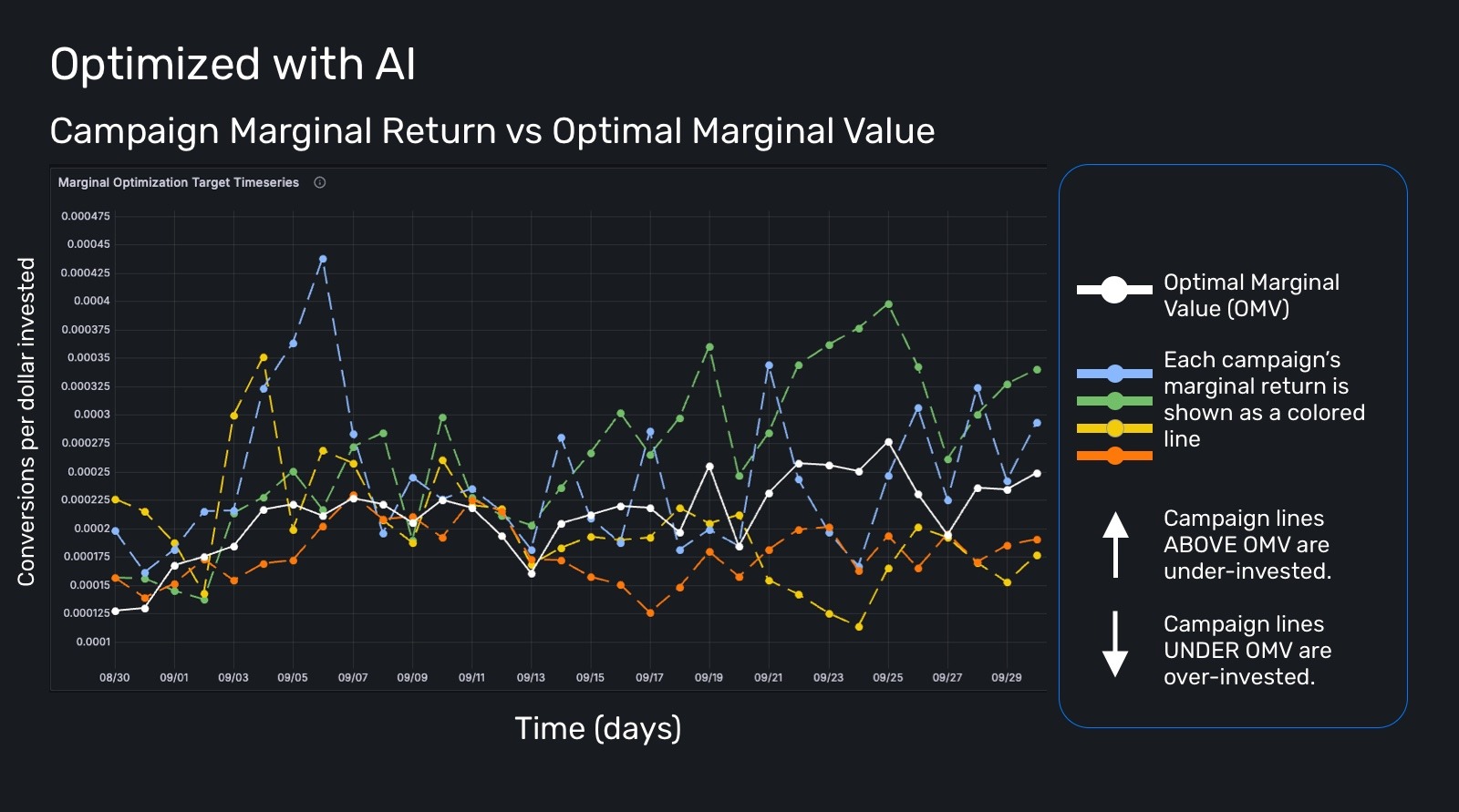
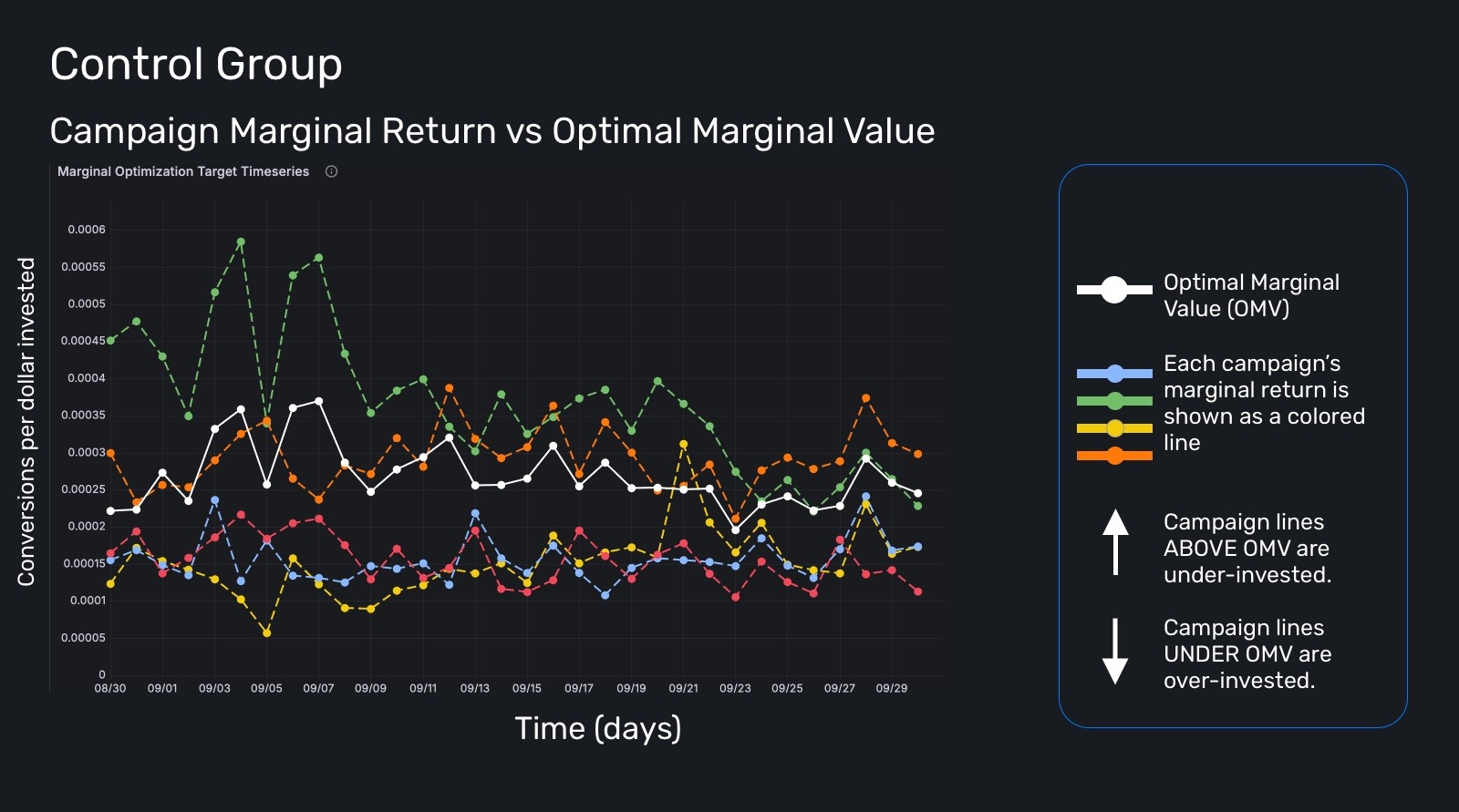
While business constraints restricted both groups from reaching the absolute mathematical optimum, the group utilizing the AI got closer. By calculating the absolute average distance from the optimal marginal return for the entire experiment period, we quantified the difference:
- The Optimized Group (With AI) measured 0.72.
- The Control Group (Without AI) measured 0.99.
This difference represents an improvement of approximately 27.27% in favor of the Optimized Group. In practical terms, this translates into greater budget allocation efficiency, resulting in a lower CPA.
Conclusion
The optimization of campaigns using the Paid Media Optimizer demonstrated a clear and significant advantage in efficiency (-12% reduction in CPA) compared with the manual optimization process (+21% increase).
The Test Group was able to assign investment more efficiently, maximizing the conversion volume permitted by individual campaign restrictions. In contrast, the Control Group displayed unevenly distributed marginals (overall further from the optimal
Conclusion
The optimization of campaigns using the Paid Media Optimizer demonstrated a clear and significant advantage in efficiency (-12% reduction in CPA) compared with the manual optimization process (+21% increase).
The Test Group was able to assign investment more efficiently, maximizing the conversion volume permitted by individual campaign restrictions. In contrast, the Control Group displayed unevenly distributed marginals (overall further from the optimal point), resulting in lower investment efficiency, as some campaigns received too much budget while others received too little.
Results supported the hypothesis that AI-driven budget optimization delivers more profitable outcomes compared to traditional methods.
Power up your Paid Media with Muttdata
At Muttdata, we believe real impact happens where technical precision meets marketing strategy. This experiment shows that in action, combining the power of AI with rigorous testing and analysis.
As advertising grows more complex, our Paid Media Optimizer gives brands a clear edge in performance. Companies that embrace AI and evidence-based experimentation will move faster and smarter. We’re excited to help lead that shift toward truly data-driven marketing.
Ready to get started? Get in touch with our team to see a free demo of our Paid Media Optimizer.
