

Why Optimizing for Leads Hurts Your Conversions (and What to Do Instead)
Mixilo AI conversions is a new feature from our Paid Media Optimizer


A closer look at how Mixilo scores leads for teams optimizing on conversions and CPA
If you run ads for a university, the number you really care about is enrollments. If you run them for a bank, it's accounts opened. But that's almost never what your campaigns optimize for. They optimize for leads. There's a good reason for that, and it's not that anyone forgot what the goal is.
Why you can't just optimize for the real thing
Paid Media Optimization models learn from feedback. To decide where the next dollar should go, it needs a steady stream of signals telling it what's working. Enrollments and sales don't give it that. There’s just not enough data. A campaign might bring in hundreds of leads a month and only a handful of enrollments, and those enrollments might show up six or eight weeks after the click. That's too few signals, arriving too late.
So teams move one step up the funnel, to leads. Now there's plenty of data, and it arrives the same day. The problem is that leads aren't all worth the same. Some people are ready to enroll. Others were just curious and never will. When you optimize on lead count, the optimizer can't tell them apart, so it happily sends budget to whichever campaign produces the most leads, even if those leads rarely convert. Your campaigns look great on leads, and enrollments don't follow in the same proportion.
Most teams end up stuck between three imperfect options:
- Optimize on leads. Fast and plentiful, but it rewards volume, not quality.
- Optimize on enrollments or sales. The right goal, but there isn't enough data for the optimizer to learn from.
- Optimize on leads and correct by hand. Wait for CRM reports, see which campaigns actually produced enrollments, and shift budget manually. It works, but it's slow, and by the time you act, the money is already spent.
This is why Mixilo scores leads individually and optimizes toward the ones most likely to convert. We've had customers running this for a while now. We just haven't talked about it much publicly, so here's how it actually works.
What Mixilo AI Conversions does
Mixilo AI Conversions gives your optimizer the best of both worlds: the volume of leads with the meaning of enrollments.
It looks at each new lead and estimates how likely that person is to become a paying customer. Then it adds up those estimates across each campaign's leads for the day. The result is a daily number of expected conversions per campaign, and that's what Mixilo uses to move budget between your campaigns.
So instead of asking "which campaign brought in the most leads today?", the optimizer asks "which campaign brought in the leads most likely to convert?"
How it works
- A new lead comes in. The model looks at signals you already have: which campaign it came from, its lead score from your CRM, how old the lead is, and its general location.
- It assigns a probability. Based on those signals, it estimates the chance that this specific lead converts. Think of it like a weather forecast: a 30% chance, not a yes or no.
- Those probabilities add up into a daily number. Ten leads at a 10% chance each add up to one expected conversion for the day, even though no single lead is a sure thing. This is what solves the volume problem. You might get one real enrollment a week, but you get a meaningful expected-enrollment number every single day, for every campaign. The optimizer finally has enough signal to work with, and that signal points at the goal you actually care about.
- We check our work. Since conversions usually take time to show up, we compare predictions against what actually happened once enough time has passed, and recalibrate as needed.
How this is different from lead scoring
You may already score leads in your CRM. That's useful, and AI Conversions actually uses it as one of its inputs. But a lead score tells your sales team which leads look promising. It doesn't tell your ad budget anything. AI Conversions turns that information into a number your budget can act on, campaign by campaign, every day.
Is this a fit for you?
AI Conversions is built for teams optimizing on conversions or CPA (cost per acquisition), not revenue. It works best when:
- The real conversion happens weeks after the lead, not minutes after
- You generate a steady volume of leads
- You have some data about your leads in your CRM or a similar system
An example is a university that optimizes on leads because enrollments are too rare and too slow to optimize on directly. Or a bank that optimizes on leads when what it really wants is opened accounts. Any business with a sales or enrollment process between the ad click and the real conversion tends to fit well.
If your lead volume is low and sporadic, the model has less to learn from. We'd rather tell you that upfront than oversell it.
Results
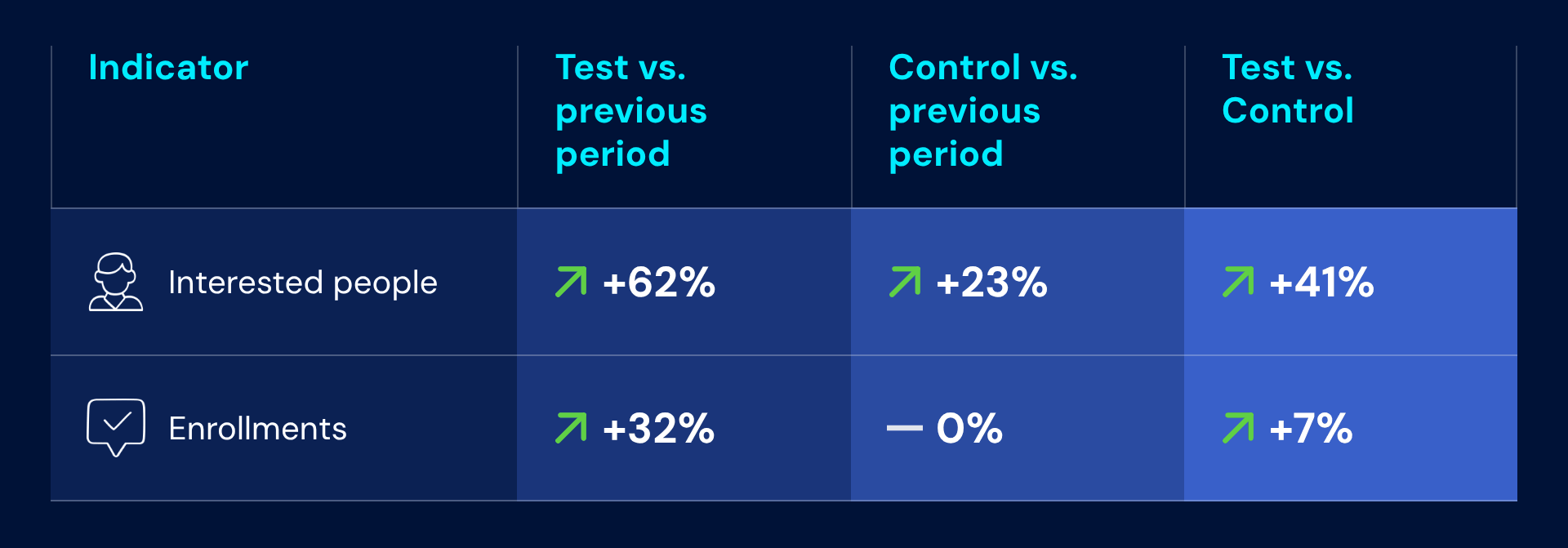
Frequently Asked Questions
- Does this require historical campaign data to get started? Is there a minimum historical volume of leads or enrollments required?
A minimum of 30 data points is enough to get started. That said, more data is always better: the larger the historical volume of leads or enrollments, the stronger the model’s performance will be. - Do I need to change how I run my campaigns?
No. This runs underneath your existing campaign structure. All it takes is switching the attribution platform setting directly in Mixilo. Our Customer Success team will walk you through it, and it only takes a few minutes. From then on, your budget allocation starts using the new metric. - What data does it need from me?
What you're likely already tracking: which campaign a lead came from, a lead score from your CRM, when the lead came in, and general location. - How is this different from regular lead scoring?
Lead scoring tells you which leads look promising. This turns that into a number your ad budget can actually optimize against, day by day, at the campaign level. - How long before I see results?
Conversions typically take time to materialize, so review performance on a rolling basis rather than day to day. - Does this replace revenue-based optimization?
No. This is built for teams optimizing on conversions or CPA. If you optimize on revenue, your setup already accounts for lead quality differently.
Latest Insights
Why Optimizing for Leads Hurts Your Conversions (and What to Do Instead)

Google is about to make your Display impressions more honest
OpenAI just launched ads in ChatGPT. Here's what marketers need to know.
