

dLocal: 100s of People Creating and Consuming Data Products with Databricks, Unity Catalog and Genie

Executive Summary: By transforming its data architecture into a self-service product with Databricks, Unity Catalog, and Genie, dLocal empowered hundreds of team members across 15 business domains to independently create and consume certified data products—cutting question-to-answer times from days to minutes while driving company-wide data adoption.
The Challenge: Building a Data Foundation For The Next Stage of Scale
dLocal processes payments across 60+ emerging markets for some of the world's largest global merchants. As the company scaled and handled billions of transactions annually across Latin America, Africa, and Asia, the volume, complexity, and strategic importance of its data grew with it.
As dLocal scaled, the data model that had supported its growth needed to evolve with it. Core metrics like transactions, gross profit and conversion rates were defined in more than one place, and a central data team carried most of the ingestion, transformation and reporting, which made consistency harder to sustain across a growing number of domains.
Consistent definitions and governance at scale were also essential for dLocal to accelerate its AI and analytics ambitions.
The next stage required more than new tooling. It required a different operating model for how data was produced, governed and consumed.
The Vision: Data as a Product, Consumed Through Natural Language
Working with Muttdata, dLocal designed and built dMesh which is a fully governed, AI-ready, self-serve data platform using data-mesh architecture, built on Databricks. But dMesh isn't just a technology migration. It represents a step change in how data is produced, governed and consumed across the enterprise.
The core principle behind the new operating model for data was simple but powerful: treat data like a product. Every dataset should be discoverable, trustworthy, self-describing, and designed for consistent downstream consumption.
Changing How Self-Service Consumption Works: Natural Language Questions
Perhaps the most transformative aspect of dMesh is how it has fundamentally lowered the bar for data consumption. Traditional self-service analytics required users to know SQL, understand table schemas, and navigate complex data models. dMesh flipped this on its head.
Federated Governance: Ownership Where the Expertise Lives
dMesh implements a federated governance model that shifts accountability for data to where the expertise actually lives, in the business domains themselves. Rather than funnelling every decision through a central committee, governance is computational and by-design.
Three roles make this work for every data product
- Data Owner - accountable for the data product overall, ensuring it solves real business problems and maintains quality. Typically a Head or VP within the domain.
- Business Data Steward - responsible for data product definitions, oversight of the data delivery pipeline, and sourcing of the data. They ensure the product's meaning stays aligned with business reality.
- Technical Data Steward - responsible for implementations, pipelines, contracts, and incident response. They keep the product running and evolving.
Governance is not a gate, but built into the platform
- Unity Catalog provides central access control, lineage, and audit across all data products
- Every asset is automatically tagged for cost and usage attribution by domain
- PII/PCI classification, hashing, masking, and access policies are applied automatically through the data contract
- Security controls are enforced at the platform level and compliance is continuous, auditable, and doesn't slow teams down
A Data Stewards Working Group meets monthly to monitor and resolve cross-domain issues, while a Data Governance Council provides quarterly sign-off and conflict resolution. But the day-to-day governance happens automatically through the platform, no manual gatekeeping required.
dRiven: The Cultural Change Programme That Makes Technology Stick
Building a self-service data platform is only half the challenge. The harder half, and the part most data mesh implementations neglect, is changing how people think about data in their daily work. dLocal recognised this from the outset and launched dRiven alongside dMesh as a deliberate, structured cultural change programme.
dRiven is not a training course about tools. It is a behaviour-change initiative designed to build three core capabilities across the entire organisation: curiosity (how to ask better questions), critical thinking (how to test assumptions and challenge headline numbers), and creativity (how to look at data from more than one angle before making a decision).
Why cultural change matters as much as the platform
The most sophisticated data platform in the world delivers zero value if people don't use it — or worse, if they use it without the skills to interpret what they find. dLocal's leadership understood that making data-informed decision-making consistent at scale required more than access to better data. It required scaling the habits, confidence and expectations that make data-informed decisions consistent across every team.
As dLocal's CEO put it at launch: "We've all seen too many versions of the same number that we can't reconcile. We've spent too much time double and triple checking data instead of using all that time to make the right decisions. Every good decision starts with a question that someone was curious enough to ask."
How dRiven works in practice
The programme is structured around four progressive learning modules and delivered through bite-sized content on a microlearning platform that build from foundational awareness to applied analytical thinking:
- Analytics Savvy - A light-touch introduction to data behaviours for the entire organisation, building strategic awareness without overwhelming non-technical staff
- Data Accountable - Deeper content on data ownership, governance responsibilities, and the "infinite feedback loop" between data consumers and producers
- Analytics Powered - Practical skills for using data products and AI-powered analytics in day-to-day decision-making
- Data Curious - Advanced questioning techniques, bias recognition, and creative approaches to data exploration
Critically, the curriculum focuses on timeless behavioural skills rather than tool-specific training. Tools change; the ability to ask a sharp question, challenge an assumption, and think critically about what data is telling you does not.
A phased rollout with built-in feedback loops
dRiven launched with a pilot cohort of approximately 100 people with data stewards, domain champions, and cultural ambassadors who tested each module, provided structured feedback, and helped refine the content before the company-wide rollout. This pilot-first approach ensured the programme was grounded in real organisational context, not generic data literacy theory.
The full launch was coordinated across multiple channels: CEO-endorsed communications, office-based "Launch Labs" with live demos, a dedicated community channel for peer exchange, and progressive leadership reinforcement through C-suite video messages from the CFO, CTO, COO, and CRO - each connecting data capabilities to their specific domain's strategic priorities.
Leadership role-modelling as a force multiplier
A distinctive feature of dRiven is its emphasis on leadership as the primary driver of cultural change. Rather than treating data literacy as a bottom-up training exercise, the programme explicitly enlisted senior leaders to role-model data-informed behaviours, publicly endorse the initiative, and connect it to their teams' strategic objectives.
Each C-suite leader recorded a personal message explaining why data capabilities matter for their function and not in abstract terms, but tied to specific business outcomes: better forecasting and capital allocation (CFO), faster diagnosis and prioritisation (CTO), earlier issue detection and consistent execution (COO), and sharper commercial decisions and growth (CRO).
Measuring cultural change, not just completion rates
dRiven tracks more than course completions. The programme measures engagement depth:
- How many people are actively asking questions in the platform
- Sharing insights with peers
- Applying data habits in their workflows
On launch day alone, 106 new users accessed the platform, 96 ran their first query, 40 organically joined the community channel, and 9 shared their results publicly, this is all without being mandated to do so.
The programme's communication strategy deliberately shifts from launch awareness through practical relevance to community-led adoption, with regular adoption checkpoints informing whether additional intervention is needed. The goal is not to create a one-off training event, but to embed data-informed decision-making as a consistent organisational habit as dLocal grows.
The Results: 80 Certified Data Products in 3 Months
The impact of dMesh has been measurable and rapid:
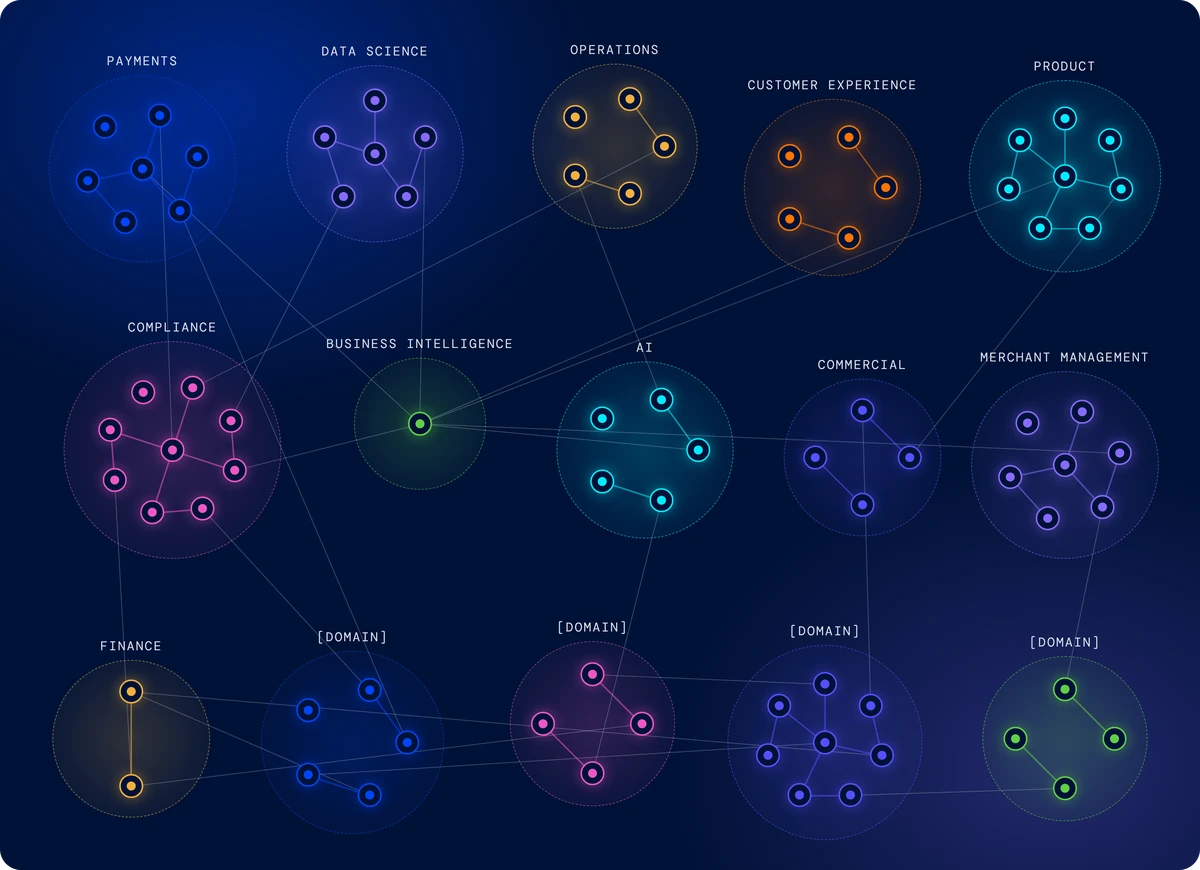
- 80 certified data products live across 15 business domains - spanning payments, compliance, merchant management, operations, commercial, customer experience, data science, and more
- 680 active users consuming certified data products in the last month, with 100+ new users on launch day generating nearly 38,000 data access events

The most-consumed data products tell the story of real business value: core transaction data products reached over 300 unique users each within the first month, with merchant and operational data products close behind. Being used daily by hundreds of people across the organisation, from account managers to product engineers to compliance analysts.
What This Means for the Industry
dMesh demonstrates that the data mesh vision which is often criticised as theoretical or impractical can be delivered at scale when backed by the right platform, the right engineering discipline, and the right partner.
The key lessons from dLocal's journey:
- Self-service consumption through AI is real - not a demo, but a production capability serving hundreds of users daily. Natural language interfaces over governed semantic layers eliminate the SQL barrier without sacrificing trust.
- Production can be democratised - when you give domain teams templated, code-first tooling with built-in governance, they can produce certified data products without deep platform engineering skills.
- Engineering discipline is non-negotiable - data contracts as code, CI/CD for data products, and automated quality enforcement are what separate a working data mesh from a collection of ungoverned tables.
- Federated governance works when it's computational - ownership, stewardship, and compliance built into the platform by design, not enforced through committees and policy documents.
- Adoption follows value - dMesh's exponential user growth came from making data genuinely easier to find, trust, and use - not from mandating adoption.
- Cultural change is not optional - technology alone doesn't change behaviour. A deliberate programme that builds curiosity, critical thinking, and data confidence, endorsed by the CEO and C-suite, is what turns a platform launch into an organisational habit.
Lowering the Bar to Self-Service Production Through AI
dMesh doesn't just make consumption easier - it has democratised data production through AI-assisted tooling and engineering best practices.
Domain teams, the people who actually understand the data, can now produce certified data products using:
- AI Skills to build the first version of a new data-product whilst cross-checking against existing data-products
- A Data Product Factory with templated CLI tooling, so creating a new data product follows a guided, repeatable process rather than a bespoke engineering project
A domain team member initiates a new data product with a single CLI command, fills out a YAML data contract defining schema, input sources, SLAs, data classification, and owners, and the platform handles the rest: governance, tagging, access policies, and deployment.
AI lowers the barrier further. The platform uses AI to assist with transformation logic, quality rule generation, and metadata enrichment, meaning domain teams can focus on business logic rather than infrastructure plumbing.
Through Databricks Genie, integrated with conversational AI tools like Glean and Claude, any employee at dLocal can now ask questions in plain English and get trusted, governed answers in seconds. A Technical Account Manager can ask "Which Brazil merchants haven't adopted Pix?" and surface cross-sell opportunities instantly. A product manager can validate A/B test results without filing a data request. A finance analyst can pull reconciliation data without waiting for the central team.
This isn't a chatbot bolted onto a database. The conversational layer sits on top of a semantic layer and governed metric views, ensuring that when someone asks about "conversion rate" or "TPV," they get the same certified definition across the organisation.
The result: time from question to trusted answer measured in minutes, not days or weeks.
Everything Defined Through Code: Engineering Best Practices at the Core
What makes dMesh genuinely different from many data mesh implementations is its uncompromising commitment to engineering discipline. Every data product is defined, tested, and released using the same standards as customer-facing software:
- Data contracts as code (YAML): Every data product carries a machine-readable contract defining its schema, owners, sensitivity classification, retention rules, and SLAs. These contracts are versioned in Git alongside the transformation logic.
- Asset Bundles for repeatable deployment: Data products are packaged as Databricks Asset Bundles, versioned, testable artifacts that can be promoted across dev → test → prod environments with full CI/CD pipelines.
- Automated quality enforcement: Soda contract checks run automatically, with results flowing into a centralised Data Quality Monitoring Dashboard. Every product is continuously validated for freshness, completeness, and schema compliance.
- Infrastructure as code: The entire platform, catalogs, schemas, policies, service principals, access controls, is managed through code, not manual configuration.
This approach means that a data product created by one payments team follows exactly the same standards, governance, and deployment process as one created by compliance or customer experience. Consistency is built into the system, not enforced through process documents.
About the Partnership
Muttdata partnered with dLocal to design the dMesh architecture, implement the data product factory, establish the federated governance model, accelerate domain onboarding, and co-develop the dRiven cultural change programme. The engagement combined deep Databricks platform expertise with practical experience in organisational change management - because building a data mesh is as much a cultural transformation as a technical one.
dMesh and dRiven together are not just technology — they strengthen the data foundation behind dLocal’s intelligence, giving every team the trusted data and the confidence to act on it as the company scales across emerging markets. And the results speak for themselves.
To learn more about how Muttdata can help your organisation build a production-grade data mesh, get in touch.
