.svg)

What Is Marketing Mix Modeling and How Can Automation Make It Even More Useful?
Marketing Mix Modeling explained: how MMM quantifies the incremental impact of every marketing dollar, why privacy changes brought it back to the center of measurement, and how automated, Bayesian MMM turns budget allocation into a daily closed loop instead of a quarterly meeting.


In this post we continue spreading the word about tools and best practices we believe can take marketing to the next level. We see great potential in modern marketing: data science, Machine Learning, and AI have generated — and will continue to generate — opportunities to help businesses grow through transformed marketing strategies. We want to be protagonists in that transformation.
At Muttdata we believe in efficient, automated, and easily customizable systems capable of removing human bias and the hassle of manual daily operations. Data science is the key to modern marketing.
Keeping Up With Budget Allocation
Budget allocation isn't a modern concept: it's been studied for decades in businesses around the world. And although some fundamental questions remain the same, the environment in which they must be answered has drastically changed. Today's markets are complex and constantly shifting.
As the ways of spending your marketing dollars multiply — and with market share, profit, and customer acquisition depending heavily on advertising — the diversity of channels leads to one core challenge:
What is the optimal way to allocate my marketing budget in order to maximize my results? Spending too little can be as much of a problem as spending too much if your marketing dollars aren't properly allocated.
Not only has this question gotten harder to answer — companies need to answer it more frequently. In the past, fewer channels meant marketing budget allocation could be revised once a year or once a quarter. Today, staying competitive and cost-effective means adjusting allocation weekly, daily, or even hourly.
There's also a measurement problem underneath: to optimize how much you spend on each input, you first need to understand how much each input actually contributes. That's the attribution question, and we compared the two main schools of thought in Multi-Touch Attribution vs Marketing Mix Modeling. The short version: as privacy changes and signal loss made user-level tracking less reliable, Marketing Mix Modeling went from "legacy technique" to the measurement backbone of modern marketing. Even Meta and Google now maintain their own open-source MMM frameworks (Robyn and Meridian) — that's how central MMM has become.
Marketing Mix Modeling (MMM) — 101
Marketing Mix Modeling (sometimes called media mix modeling) is a statistical analysis technique used to quantify the effectiveness of the different components of a marketing strategy in terms of a specific KPI, such as sales, market share, or return on investment (ROI).
TL;DR: MMM quantifies the incremental impact of a marketing activity on a predefined KPI. If I invest an additional dollar, how much does it move my KPI?
Why is this relevant? The marginal impact of a campaign — its elasticity — isn't just about what an additional dollar does to a KPI, but what that difference tells us. Imagine a campaign where every additional dollar invested returns one dollar or less in sales. That's a saturated campaign, which translates into inefficient budget allocation. (We went deep on this exact mechanic in our posts on ad response curves and ROAS vs marginal ROAS.)
MMM is useful for allocating budget across campaigns, channels, or products — and for forecasting the impact of different spending scenarios in future campaigns.
In a not-so-distant past, marketers might have found a great mix through intuition, experience, or luck. The problem was replicating that strategy, and tweaking it over time as the industry and customers changed. MMM gives marketers a systematic way to understand the variables at play and their effect on ROI, sales, or any KPI that matters.
So what's behind a Marketing Mix Model? Most MMMs are based on regression techniques that predict the outcome of a dependent variable (say, sales) using various explanatory variables (say, spend on each channel or targeted discounts). Modern implementations favor Bayesian Marketing Mix Modeling: you form an initial estimate (a prior) and improve it as you gather more data (the posterior) — which also lets you express uncertainty honestly instead of pretending the model knows more than it does.
How Does Marketing Mix Modeling Work?
Like most models, the fuel is data. Once the scope and the relevant KPIs are defined, data has to be collected — product, pricing, sales, industry, and economic context, depending on what you're modeling. Then data scientists clean and process it. This first step is crucial: models are only as good as their data.
With data in the tank, the modeling begins. MMMs ingest historical data and analyze cost curves to predict revenue for different channels and campaigns, considering constraints and spending levels.
Constraints are set by the marketing team and vary: minimum or maximum spend, minimum return on investment, and sometimes time-dependent rules — different behavior on weekdays vs weekends, for example.
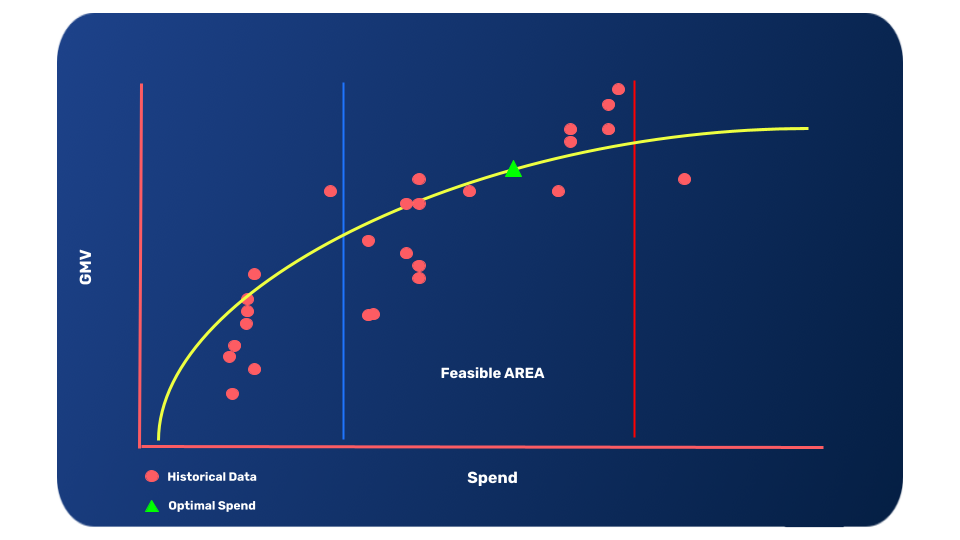
This is not a one-time task. Models are constantly tweaked, tuned, and adapted as new data inputs are introduced. Using Bayesian Linear Regression we search for the cost-revenue distribution. This model demonstrates the Bayesian framework: we form an initial estimate (a priori) and improve our estimates as we gather more data (a posteriori).
What Makes MMM Attractive to Marketers?
Optimized Budget Allocation
A growing number of channels and ways to spend makes it critical to measure the real profit you can expect from each one. Modeling lets marketers optimize marketing budget allocation and maximize returns.
Improved Visibility / Scenario Testing
There's no perfect formula for good business, but MMM lets teams play out scenarios: what happens if we push this channel x%? If we need an x% lift in sales, how much more should we spend, and where?
Privacy-Proof Measurement
MMM works on aggregate data — no cookies, no user-level tracking, no consent-banner dependency. As privacy regulation tightens and signals degrade, that's no longer a nice-to-have; it's the reason MMM is back at the center of the measurement stack.
Marketing Mix Modeling vs Automated Marketing Mix Modeling
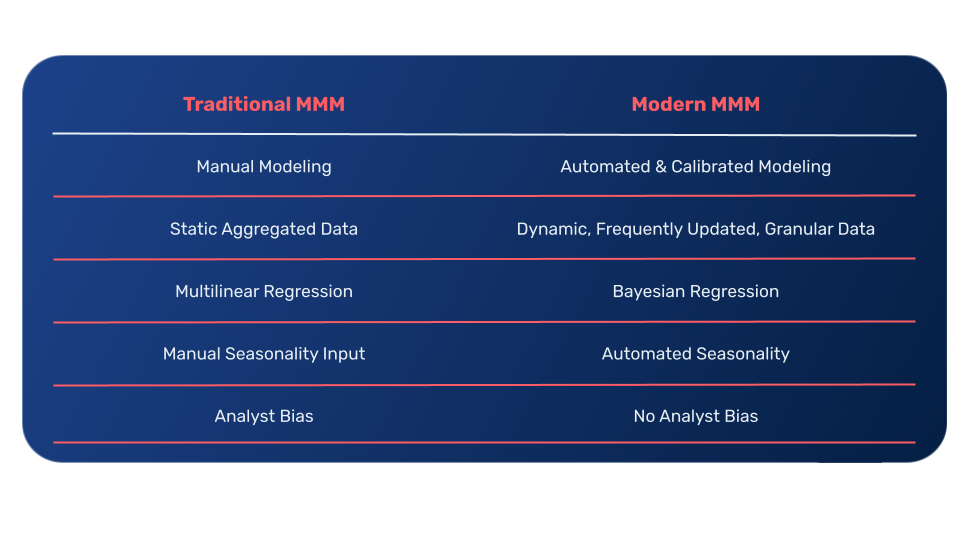
We've covered the fundamentals. Now, how can automation make MMM even better? Machine Learning and automation play the key role in this generation of Marketing Mix Models. Here are the main differences between conventional MMM and automated marketing mix modeling.
Frequency. Conventional modeling is manual and slow, based on static, aggregated data spanning years. Those models decay, and they make timely decisions harder. Automated systems continuously update with new data: by integrating with channel APIs, they receive performance data, centralize it, clean it, estimate the response curves, and find the optimal allocation — daily or even hourly.
Action, not just insight. Once the optimal budget allocation is found, an automated system can apply the suggested configuration directly to the ad platforms, without an analyst in the loop for every change. Decision-making becomes a closed loop: measure, model, allocate, repeat. This is what we mean when we talk about fluid budgets — budgets that move at the speed of the market instead of the speed of the monthly meeting.
Exploration vs exploitation. Budget must be allocated under uncertainty — you don't know in advance which campaigns will be most profitable. Automated strategies continually balance gathering information about campaigns (exploration) with committing budget to the best-known options (exploitation), borrowing well-studied principles from statistics and reinforcement learning.
Adstock and lag. Advertising decisions don't impact outcomes immediately: effects build up and decay progressively (the adstock effect). Good automated MMMs model this explicitly instead of assuming today's spend explains today's sales.
Data inputs. Traditional MMMs ran on spreadsheets assembled manually by analysts. Modern systems use automatic integration through APIs, gathering granular information from many sources into databases with millions of data points — which trains meaningfully better models.
Validation. Any model can be wrong. Standard MMMs rely on statistical validation alone; the current gold standard is validating against ground truth through incrementality experiments (lift tests) — deliberately holding out regions or audiences and comparing the model's predictions against measured reality. Model plus experiment beats either one alone.
Why Muttdata?
Our mission at Muttdata is to help companies drive business value by developing automated data and AI products. We build long-term solutions that remove the daily hassle of manual, human-biased operations, so the people we help can focus on high-level decisions.
Our team of Data Nerds has deep experience building automated systems of all kinds: ad platforms, real-time bidders, fraud prevention, attribution systems, and Marketing Mix Modeling optimization systems. If you're evaluating marketing mix modeling companies, here's our honest differentiator: we're not a SaaS you configure and hope for the best — we're the team that builds the model around your business, with adaptable, scalable solutions and interfaces that non-technical teams actually use.
Ideally, the people in charge of modeling should combine statistical know-how with market experience — understanding both the technical needs of the model and the business variables at play. At Muttdata, that's the whole point of the team: mathematicians, data scientists, data engineers, economists, marketers, and statisticians working together. Over the years we've built these systems for some of the world's largest online marketplaces, renowned financial institutions, and key telecommunications companies.
Wrapping Up
We hope you've found this post useful, and at least mildly entertaining. If you want to see how automated Marketing Mix Modeling and fluid budget allocation could work on your data, talk to our team or explore our case studies.
Latest Insights
OpenAI just launched ads in ChatGPT. Here's what marketers need to know.

Google Ads Target CPA & Target ROAS Bidding Change: What to Know

Mixilo Now Calculates Your Target, Not Just Your Optimal Spend
