.svg)

MarTech Trends 2026: Better Questions Beat Better Tools
The key components of a MarTech stack haven't changed — how you connect them has. Five shifts defining which marketing teams win in 2026.


Why 2026 won't be won by a bigger MarTech stack but by better questions and better experiments.
Every year brings a new wave of MarTech promises: smarter AI, more automation, faster insights, better optimization. And every year, many organizations adopt new tools only to find that results don’t materially improve.
The real competitive edge in 2026 won’t come from collecting the most shiny tools. It will come from adopting the right ways of working — disciplined experimentation, rigorous hypotheses, and systems that enable confident decisions.
Before your MarTech stack can evolve, it helps to know what it actually is
A MarTech stack is the collection of software tools and platforms a marketing team uses to plan, execute, measure, and optimize campaigns. The key components of a MarTech stack typically include:
- Data infrastructure — where customer data lives and how it's unified (CDPs, data warehouses, lakehouses)
- Analytics & measurement — attribution tools, MMM platforms, dashboards
- Activation & channels — email, paid media, push, SMS, CRM
- AI & automation — optimization engines, creative generation, predictive models
- Governance & privacy — consent management, data access controls
Most organizations have tools in each of these categories. The 2026 challenge isn't filling gaps — it's making these layers talk to each other, trust each other, and work as a system rather than a collection of vendor contracts.
That's what the rest of this post is about.
1. The Next Phase of MarTech: Control Through Composability
Interestingly, the challenge isn’t a lack of interest in new technology — it’s a desire to retain control. Many teams prefer to build or manage solutions internally, even as stacks grow more complex and harder to operate. The result is well-intentioned ownership that often leads to fragmented architectures and slower execution.
This is precisely why composable architectures matter: they allow teams to retain strategic control in-house, while leveraging external platforms and partners where specialization and scale are required — without locking the organization into rigid, monolithic systems.
The future of MarTech lies in composing flexible, interconnected data and activation layers — exactly what the key components of a modern MarTech stack should do — delivering a single source of truth and operational agility. This is where Composable CDPs drive real competitive advantage. A Databricks composable CDP, for example, unifies customer data, analytics, and activation into a governed, scalable foundation — so your team can move from insight to action without waiting on a separate data team.
TL;DR: The value of your MarTech stack will come less from point solutions and more from composability, integration, and orchestration.
2. Data Quality & Integration Will Eclipse Feature Wars
AI hype is real — but without reliable data, AI delivers noise, not value. Data quality repeatedly surfaces as the core constraint to AI performance and marketing success.
Data quality used to be framed as a reporting problem. In 2026, it is a business performance constraint. Measurement, predictive models, paid media optimization, and GenAI systems all depend on:
- Consistent definitions
- Reliable pipelines
- Integrated first-party data
Measurement approaches that don't rely on third-party cookies — using your own data and statistical models instead — are now the baseline for teams that are serious about performance.
Platforms such as AppsFlyer, Databricks, and AWS illustrate how different approaches to data and activation can coexist within modern MarTech stacks. AppsFlyer offers a more self-serve, marketer-friendly experience, while Databricks and AWS are typically leveraged by more technical teams and support more advanced, customizable use cases—particularly in multi-cloud environments. Together, these platforms also enable secure audience sharing across organizations, unlocking collaboration while maintaining governance and data control.
TL;DR: Tools that promise automated insights will fail without disciplined data governance. In 2026, the question won’t be “Can AI run this?” — it will be “Can we trust what it’s running on?”
3. AI Isn’t the Outcome — It’s the Assistant
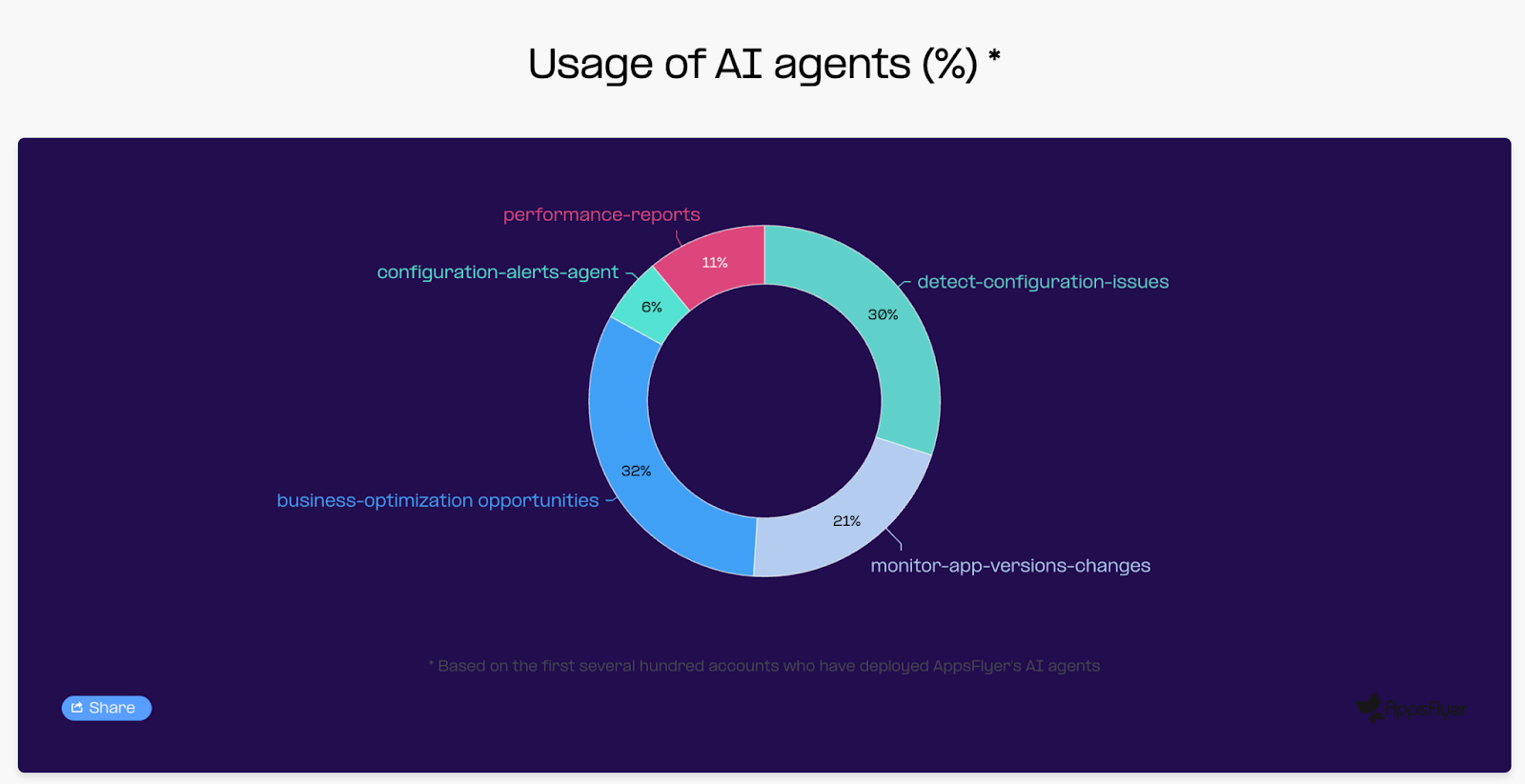
Industry data shows AI usage expanding beyond mere task automation into optimization roles, with roughly 57% of marketers already using technical AI agents and a growing proportion using optimization-oriented agents for campaign decisions (1)
High-performing organizations will:
- Understand AI isn’t always the best solution
- Use GenAI to accelerate analysis, not replace judgment
- Apply AI-driven recommendations within clear guardrails
- Continuously test AI outputs against business outcomes
One of the strongest use cases for adopting AI in marketing operations is paid media optimization, where ROI can be measured clearly and quickly. As the industry continues to move toward multi-channel, multi-campaign strategies, teams need to efficiently measure, compare, and optimize performance across channels. When AI is applied as an assistant within these systems, paid media operations become more data-driven, scalable, and better equipped to turn insights into impact.
Another immediate and high-impact opportunity is the large-scale creative production with GenAI. Marketing teams, especially those in acquisition and trade marketing, face chronic bottlenecks: manual asset production limits campaign volume, creates brand inconsistencies at high volume, introduces human errors in data and specifications, and hampers rapid market response. GenAI breaks these limitations by producing thousands of hyper-personalized visual variants (banners, social posts, product visuals, mockups) in minutes, leveraging existing product catalogs, simple briefs, and brand guidelines. This frees up teams to focus on strategic design and optimization instead of repetitive tasks.
TL;DR: AI will amplify existing maturity. It won’t compensate for the lack of it. AI governance and experimental validation will determine whether it helps or hurts ROI. Early adopters are already seeing meaningful gains from AI-driven paid media optimization, proving its value when applied within well-structured marketing operations.
4. Measurement Must Be Built, Not Bought
The last few years have reminded us that attribution dashboards alone don’t answer strategic questions. Global mobile and cross-platform engagement patterns show that users frequently move between devices and formats. Combined with privacy constraints, this signal fragmentation has accelerated the adoption of aggregate, model-based techniques (like Marketing Mix Modeling (MMM) and probabilistic conversions).
Moreover, The Digital Marketing Institute reports that 69% of consumers trust recommendations from influencers over direct messaging from brands (2) as a result, more and more brands are starting to shift budget to influencer marketing. About 80% of brands either maintained or increased their influencer marketing budgets in 2025, with 47% raising budgets by 11% or more (3). Unfortunately, techniques like MMM are not well suited to track this, as they need long periods of sustained investment and online attribution signals. In these cases, more advanced statistical techniques can be used to isolate what actually caused a result — separating real impact from coincidence.
All this to say, given the complexity and multi-channel nature of modern marketing, in 2026, measurement won’t live in isolation — it will be tightly coupled with activation and optimization. Marketers will increasingly demand live feedback loops where measurement informs decisions in near real time. Industry trend voices make this pivot clear: measurement is shifting from retrospective to real-time and integrated with execution.
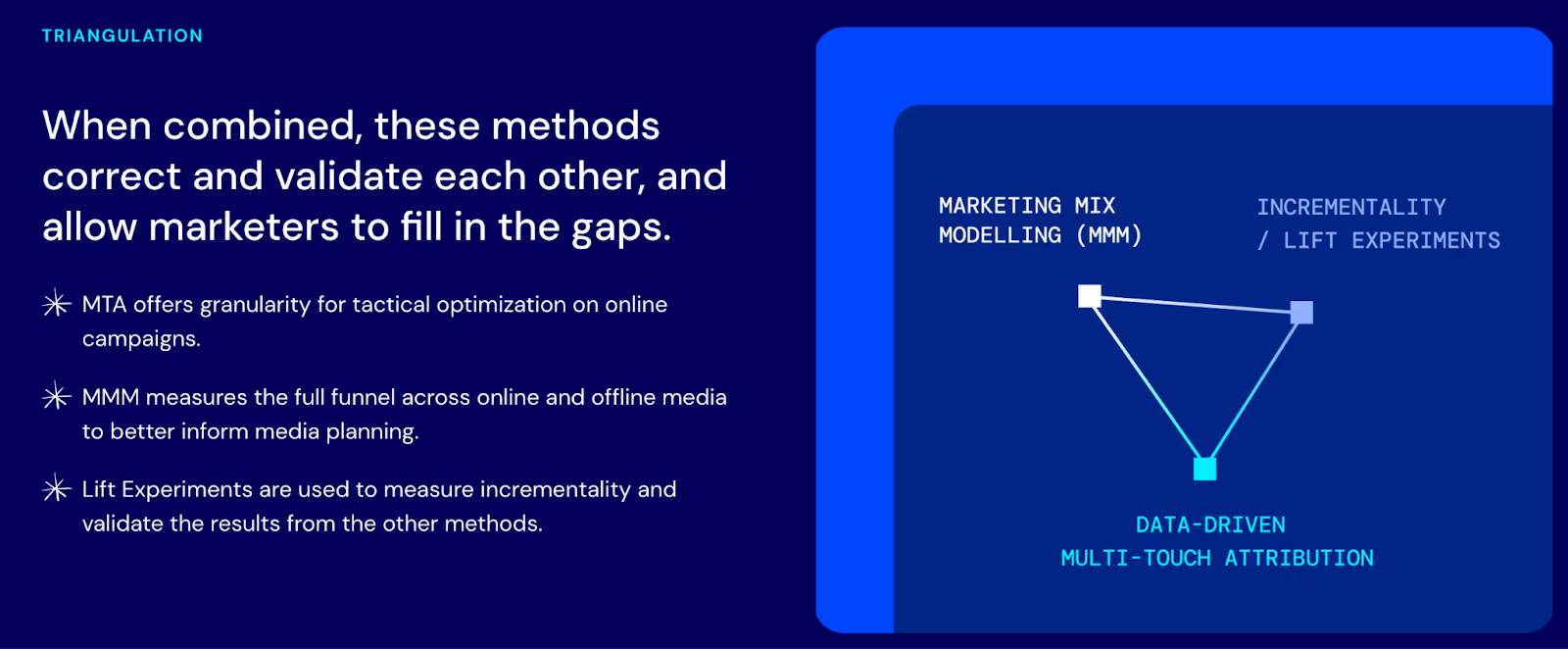
TL;DR: Understanding journeys — not just touchpoints — will be critical in 2026 measurement strategies. The future of measurement is not reactive reporting — it’s continuous learning systems that connect experiments, hypotheses, and decision frameworks.
5. Experimental Discipline Will Replace Buzzword Adoption
The most consistent pattern we see across organizations is this: performance improves when teams adopt an experimental mindset. As the MarTech ecosystem continues to mature, the teams that win won’t be the ones who adopt the most features — they’ll be the ones who:
- Start with hypotheses about what outcomes a capability will impact
- Define guardrails and success criteria before implementation
- Validate through controlled experiments or incremental tests
- Scale only what proves incremental value
For example: when the largest banks in Peru set out to try AI for Paid Media Optimization, they set up a phased implementation and test to evaluate the tool and validate its impact. The BCP team not only embraced innovation, but did so with the rigor required to validate results, manage internal change, and scale learnings. This combination positions them as leaders in the effective adoption of AI in paid media.
TL;DR: Your operating model — not your stack size — will define your competitive edge.
Wrapping up
The best teams don’t chase novelty; they build for scale.
Organizations that invest in how they work — not just what tools fill their MarTech stack — will see disproportionate impact in 2026.
“Our mission is to guide companies into an AI-fueled future. We’re proud to have worked alongside some of the largest players in LATAM, including building the region’s largest generative AI retail media case in partnership with Amazon Web Services and Mercado Libre. We’re excited to continue building solutions that are not only transformative but built to last.” Juan Martin Pampliega, CEO at Muttdata
As you plan for 2026:
- Don’t chase every new feature — build disciplined experimentation frameworks
- Prioritize data readiness before AI acceleration
- Embed measurement into execution, not after it
- Choose partners and platforms not just for capabilities, but for track records and governance discipline
Do you agree with these trends?
What other shifts are you seeing in the MarTech space—and which ones are you most excited to implement?
Get in touch to explore how to turn your MarTech stack into a real driver of growth in 2026 without adding a single new vendor.
Sources
(1) Appsflyer, Top 5 Data Trends of 2025 and Predictions for 2026 (2025)
(2) BusinessWire, Consumers Continue to Seek Influencers Who Keep It Real, (February 2025)
(3) PRNewswire, Influencer Marketing in 2025: New Data Reveals What Works, What Costs, and What's Next (June 2025)
Latest Insights

OpenAI just launched ads in ChatGPT. Here's what marketers need to know.

Google Ads Target CPA & Target ROAS Bidding Change: What to Know

Mixilo Now Calculates Your Target, Not Just Your Optimal Spend
