.svg)

Fluid vs. Fixed Budgets: How AI Budget Optimization Wins in Volatile Markets
Fixed budgets leave money on the table. See how AI budget optimization and fluid budgets capture marginal ROAS in real time — without giving up control.

For CMOs and Heads of Paid Media, one of the most important responsibilities is making sure every dollar of media investment drives measurable growth. Most organizations still rely on fixed budgets — allocating spend at the start of the month or quarter and sticking to it. That makes planning easier, but in fast-moving markets it can quietly leave money on the table. This is where AI budget optimization changes the equation.
But as AI-driven optimization gains traction, leading marketers are adopting fluid budgets, treating budgets as dynamic resources that adapt in real time to performance signals. The shift isn’t about giving up control; it’s about creating smarter guardrails so investment can flow to where it delivers the most value.
In this post, we’ll unpack the key pros and cons of fixed budgets vs fluid budgets, and address common questions marketers have when considering this shift.
What Is AI Budget Optimization? (And What It Isn't)
AI budget optimization is the practice of letting an AI system reallocate paid media spend in real time — within limits you define — to chase the best available return. It isn't handing your budget to a black box. You still set the total spend ceiling, the ROI targets, and the pacing rules. The AI simply moves money between campaigns and channels faster than any human could, based on live signals like CPC, CTR, and marginal ROAS.
Think of it as the engine behind fluid budgets: the strategy stays yours, the micro-adjustments get automated.
Fixed Marketing Budgets
Fixed budgets are the traditional model most marketers know well. Budgets are set for a channel, campaign, or platform at the beginning of a month or quarter.
Sometimes budget rigidity isn’t strategic — it’s structural. Different teams own different budgets, and alternative allocation models can become organizationally complex.
Pros of fixed marketing budgets
- Predictable spend for finance teams
- Easier to plan and report
- Useful in stable, low-volatility environments
Cons of fixed marketing budgets
- Performance blind spots — underperforming campaigns may continue receiving spend
- Opportunity cost — high-performing campaigns may get capped prematurely
- Limited agility in fast-moving markets
Sometimes budget rigidity isn’t strategic — it’s structural. Different teams own different budgets, and reallocation becomes organizationally complex.
Best Use Case
Small or limited budgets. Stable markets, experimental pilots, budgeting exercises
Fluid Marketing Budgets: AI Budget Optimization in Practice
Fluid budgets operate within boundaries set by marketers — total spend caps, pacing expectations, ROI targets — but allow AI to adjust allocations dynamically. This is AI budget optimization in its most practical form: the strategy stays human, the micro-decisions get automated.
Pros of fluid marketing budgets
- Redirects spend toward what’s working in real time
- More precise budget pacing:
- Prevents wasted investment in underperforming areas
- Captures incrementality — and protects marginal ROAS — in high-performing campaigns before competitors do
- Captures seasonality in budget allocation (daily, weekly, special dates, etc)
Cons of fixed marketing budgets (and why they’re solvable):
- Less predictability day-to-day → easily solved with boundaries and alerts
- Requires trust in AI → start with a test, monitor with transparent reporting
Best Use Case
Ideal for brands operating in competitive markets and focused on performance-driven growth or scaling campaigns. Marketing teams appreciate not having to constantly babysit platforms to avoid over- or under-spending. AI and automation keep budgets on track while providing real-time visibility through alerts and smart pacing rules.
Real-Time Responses to Real Market Signals
One of the most tangible differences between fixed and fluid budgets shows up in how they respond to everyday market dynamics.
In any paid media environment, the key performance signals — what each click costs (CPC), how often people click (CTR), and how often they convert (CVR) — fluctuate continuously. These shifts reflect changes in competition, user behavior, and demand, and they directly affect the efficiency of each additional dollar spent.
In a fluid budget setup, AI monitors these signals daily and adjusts allocations accordingly. During a recent experiment for Ripley, a large retailer in LATAM, we observed that budget changes in the AI-optimized group closely tracked movements in CPC, CTR, and CVR. When conditions improved, spend increased to capture incremental opportunity. When efficiency declined, spend was pulled back to avoid diminishing returns.
Image Description: CPC vs Actual spend for the AI-Optimized group.
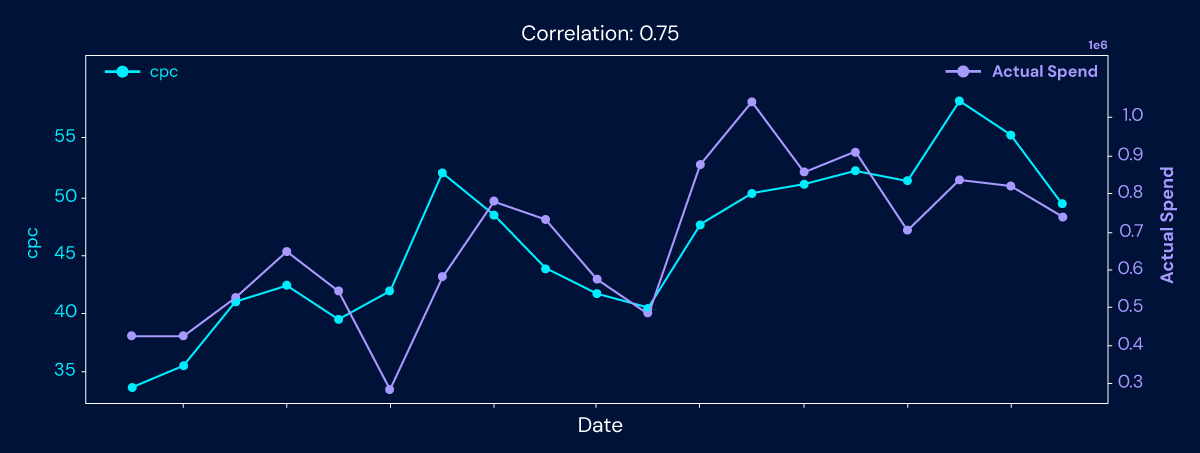
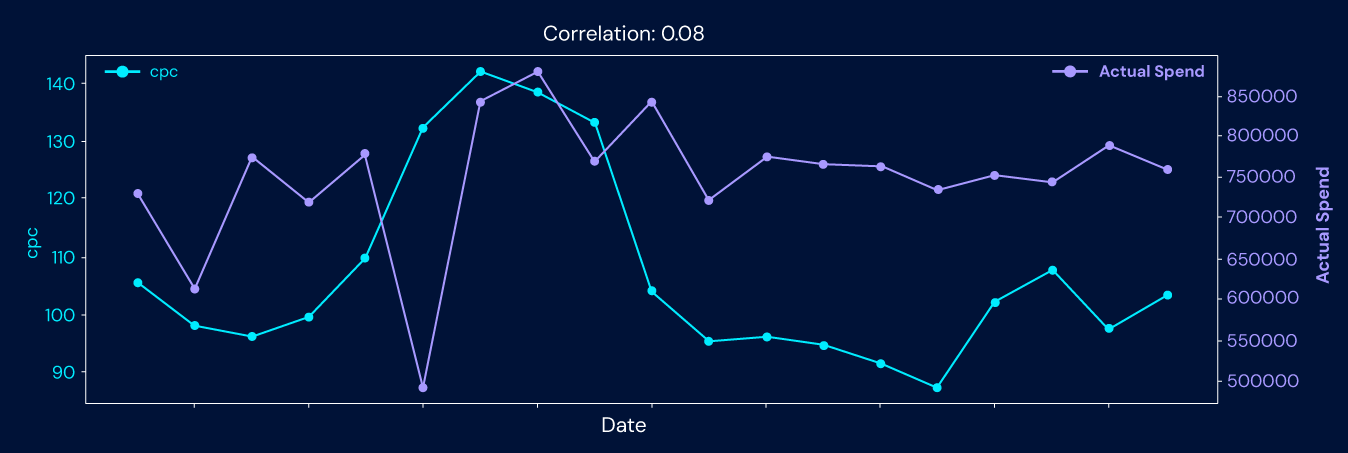
Image Description: CPC vs Actual Spend for the Control group.
One example that often surprises teams — and it comes down to marginal ROAS:When CPC increases, maintaining the same ROAS can actually require more investment — not less — to reach the same volume of high-quality traffic. Because the return on each additional dollar (your marginal ROAS) shifts constantly, a static budget can't react soon enough. A fluid one can.
In contrast, campaigns managed with fixed budgets tended to remain largely unchanged throughout the period. Spend levels stayed relatively flat even as market conditions shifted, meaning they didn’t fully benefit from favorable moments — or protect themselves as effectively during less efficient ones.
This adaptability is one of the practical strengths of fluid budgeting. Rather than waiting for weekly or monthly reviews, the system continuously fine-tunes allocations to reflect what the market is doing right now.
The result isn’t constant change for its own sake, but many small, informed adjustments that compound over time — helping teams capture short-term opportunities and reduce waste without increasing total spend or adding operational complexity.
Implementation: Moving Toward Fluid Budgets in Phases
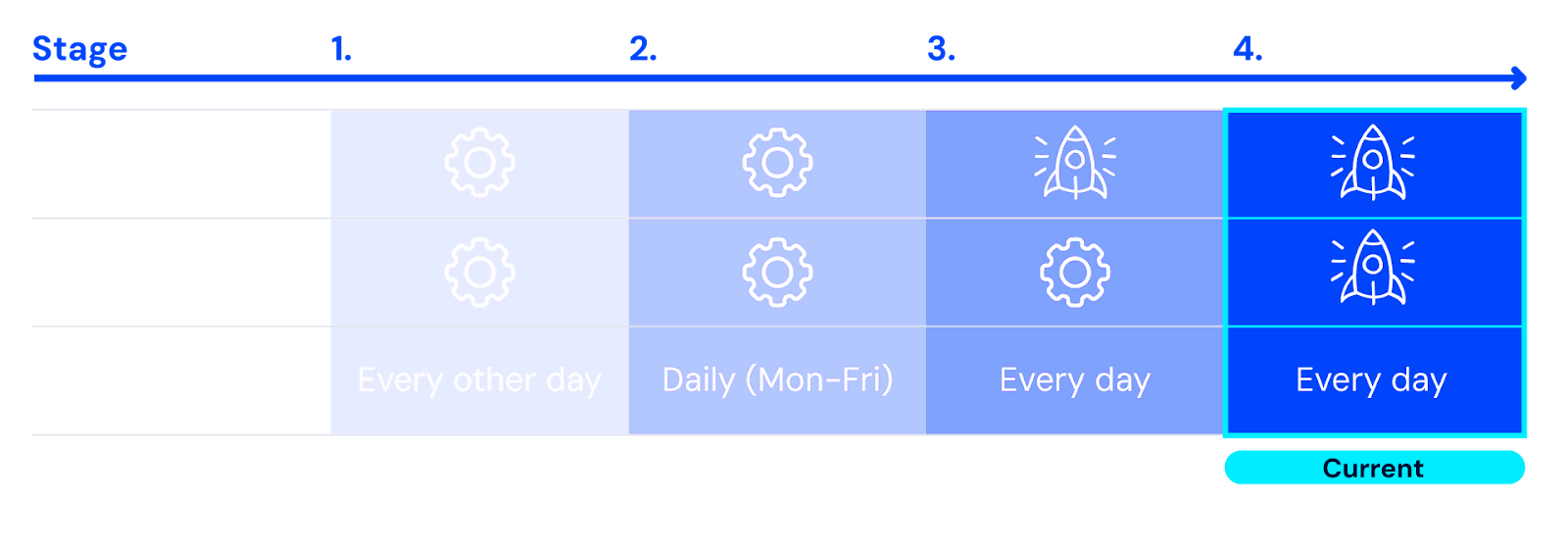
A common question after seeing how fluid budgets work in practice is how to implement them without disrupting existing processes. In reality, successful adoption rarely happens all at once.
In our recent success story with BCP, one of the largest banks in Peru, the team deliberately chose a phased approach to introducing fluid budgets.
So... When is it a good time to shift to fluid marketing budgets?
If your planning cycles still look the same as they did three years ago, it may be time to reevaluate. Fixed budgets give predictability but often at the cost of efficiency. Fluid budgets, powered by AI, offer a way to maximize return on investment without giving up control.
Think about it this way:
- Fixed marketing budgets are like setting your car’s cruise control and hoping the road stays straight.
- Fluid marketing budgets are like using adaptive cruise + lane assist — you’re still in control, but the system helps you adjust faster than a human could.
One way of testing this model is to validate with experiments: identify a portion of spend where you can allow AI-driven reallocation within clear boundaries. Measure the uplift in ROI compared to fixed-budget campaigns.
The companies that win in the next era of digital media won't be the ones with the biggest budgets — they'll be the ones with the smartest, most adaptive ones. Increasingly, that means pairing human strategy with AI budget optimization.
How to Smartly Test/ Implement Fluid Budgets
Moving from fixed to fluid doesn’t have to be a leap of faith. The smartest approach is to test in controlled environments first, then expand as you build trust in the process. A few practical steps:
- Start with clear guardrails. Define total spend limits, ROI targets, and pacing expectations so you’re comfortable with the boundaries.
- Test incrementally. Apply fluid budgets to a subset of campaigns or channels to see the difference in efficiency versus fixed.
- Review often. Transparency is key — make sure you can easily see how budgets are shifting and why.
👉 And yes, we have just the platform for this. Our Paid Media Optimizer, Mixilo allows you to set your guardrails and constraints, then provides daily recommendations on where to shift spend for the best return. You stay in control of the strategy; the AI handles the micro-optimizations at scale.
Interested in seeing it in action? 👀
Get in touch with us for a demo and see how AI budget optimization with Mixilo can drive higher returns from your existing spend, not a bigger budget.
Still have questions?
Frequently Asked Questions about Fluid Paid Media Budgets
1. Will the Finance team accept fluid budgets?
Fluid or dynamic doesn't mean unlimited. Finance still gets clear caps and forecasts, but within those limits, the budget can flex to maximize returns. It’s about shifting spend intelligently, not increasing it.
2. Will this make my budgeting unpredictable?
Not necessarily. You still set the total spend ceiling, so the finance team has clarity. What changes is how the allocation shifts within that ceiling.
3. How does this align with quarterly planning cycles?
Fluid budgets can coexist with quarterly plans. Instead of locking allocations, you lock investment ranges or guardrails, allowing agility without losing accountability.
4. What if I don’t trust AI to handle budget allocation?
Think of AI as an enhancement, not a replacement. You still set strategy, guardrails, and KPIs. You define objectives and limits; the AI fine-tunes distribution within them. AI simply manages micro-decisions at a speed and scale humans can’t. Transparency dashboards can help you monitor performance and reallocation in real time.
5. What if AI overspends?
Modern systems are designed with strict boundaries. Think of it as an autopilot: it optimizes continuously but can’t go outside the flight plan you define.
Latest Insights
OpenAI just launched ads in ChatGPT. Here's what marketers need to know.
Google Ads Target CPA & Target ROAS Bidding Change: What to Know
Mixilo Now Calculates Your Target, Not Just Your Optimal Spend
