.svg)

Why All Our Pilots Are A/B Experiments
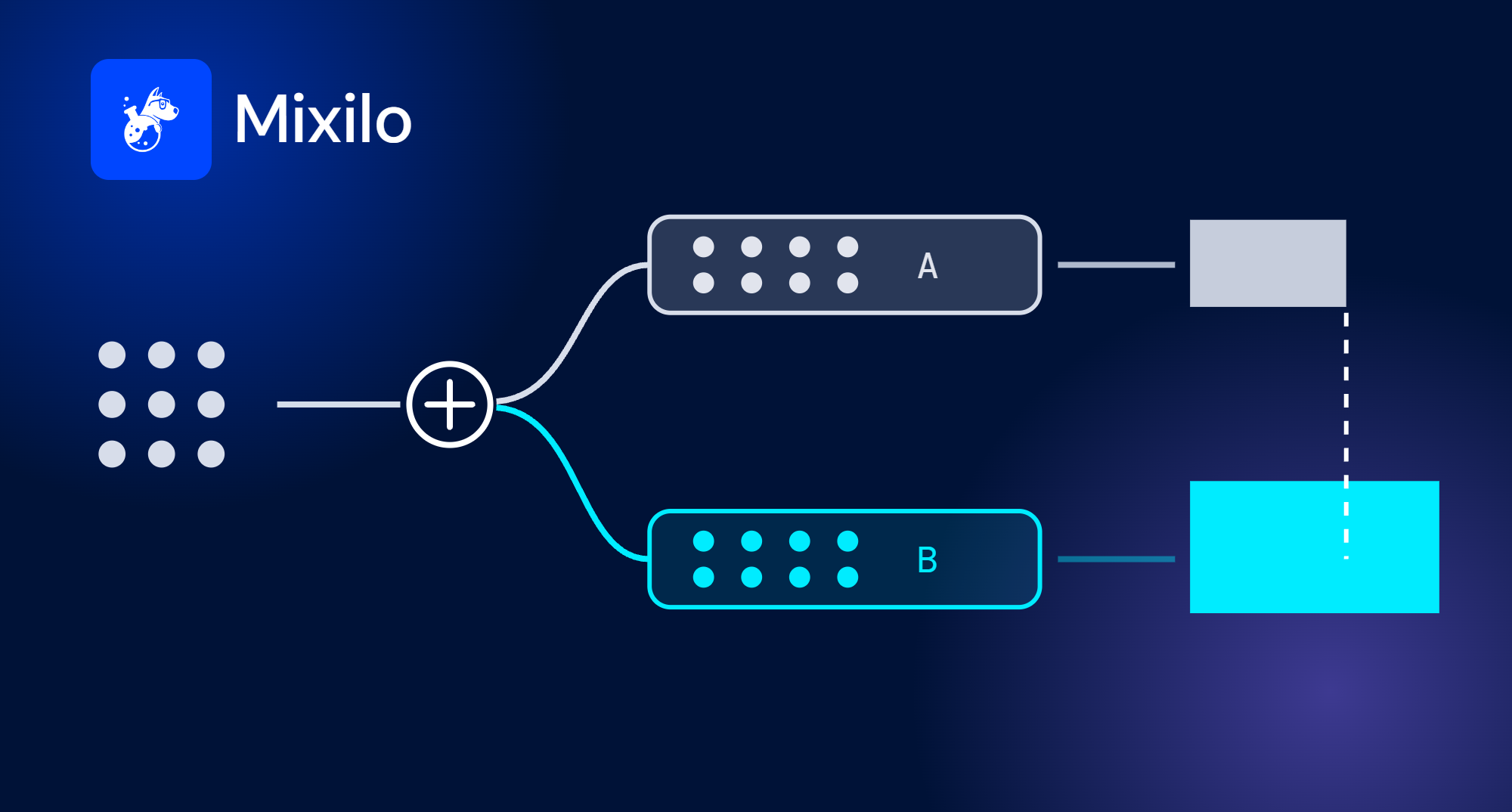
When you run Mixilo against your current way of optimizing in a A/B test the question stops being "did the numbers improve?" and becomes "did the numbers improve because of this?"

We know Mixilo works.
We have results in retail, education, and banking. Across CPA, ROAS, and conversion goals. In markets with different levels of competition and different campaign structures. The optimization engine has been tested under different enough conditions to give us conviction in what it does.
We could run pilots a different way. We could give you access, let you run the platform for a month, and show you a dashboard with the numbers at the end.
We don't do it that way. And the reason says something about how we think about the relationship with the teams we work with.
The context performance teams operate in today
There have never been so many AI tools promising the same thing: more efficiency, less manual work, better results.
And it's never been harder for a marketing team to justify adding a new tool. CMOs are under pressure. CFOs are auditing every line of the stack. And the question nobody wants to ask out loud is: how do I know this is actually driving impact, and not just measuring well?
That pressure is legitimate. And a pilot without a control group doesn't solve it — it ignores it.
What makes an A/B test different
When you run Mixilo against your current way of optimizing in a controlled experiment, the question stops being "did the numbers improve?" and becomes "did the numbers improve because of this?"
That's a distinction that matters. Markets shift. Seasons change. A campaign can improve for ten different reasons that have nothing to do with the optimizer.
The control group freezes those variables. What's left is the real, isolated, measurable impact.
At the end of the pilot, you get a report that doesn't require faith: it shows exactly what happened in the optimized group versus the control group, on the metrics that matter to your business. That report is designed to be easy to present — to your team, to your CFO, to whoever needs to approve the decision.
What we found when we measured it this way
Three recent experiments, three different contexts:
Social Learning, an education-sector company optimizing CPA: the Mixilo group lowered cost per conversion by 12%. The control group, managed manually over the same period, raised it by 21%.
Ripley, a LATAM retailer with a revenue growth goal: the optimized group grew net revenue by 19% with a 25% increase in spend. ROAS dropped by only 5% — when historically that level of scale had destroyed up to 40% of ROAS.
Mabe Mexico in Brand Search campaigns: an increase in Impression Share, 12% less spend, and 13% more conversions as a result. A visibility goal that ended up improving performance too.
In all three cases, the only variable changed was budget allocation. Everything else — creatives, targeting, objectives — stayed intact. That's what makes the numbers credible: we know exactly what to attribute them to.
What that means in practice
We're not asking you to trust us. Let's measure it together.
If Mixilo works on your campaigns (and we have a lot of evidence that it will), the numbers will be there. If it doesn't work, the numbers will be there too — and you'll know before committing real budget.
It's the most honest way we've found to start a business relationship. And, incidentally, it's also the most convenient for you.
Our pilot is designed together with your team and runs for 4–8 weeks across at least two channels. If the numbers confirm what we expect, we move to a license, unlocking additional features so your team can dig even deeper into performance. We explain how that transition works here.
Want to see what the experiment design would look like for your campaigns? Book a demo. In 30 minutes we'll map out the pilot structure and show you what you can expect to measure.
Latest Insights
Google is about to make your Display impressions more honest
OpenAI just launched ads in ChatGPT. Here's what marketers need to know.
Google Ads Target CPA & Target ROAS Bidding Change: What to Know
